
COLLECTION
Obscene, criminal, dirty, damned. Every body in this room has been called at least one of those by an institution with the power to make it stick. Two men having sex, a Greek vase painting cut in marble. A naked woman chained in the fire of Purgatory in ruby red heels. A horned woman spinning on a bearing. A Gede and a mambo at a lit altar with their sex out. Six works, 1997 to 2017, and every one treats the body as the place the sacred happens.

La Siren III, top right, installed at the Grand Rapids Public Museum in 2017 in Mythic Creatures: Dragons, Unicorns & Mermaids, the American Museum of Natural History touring exhibition. Photograph by Alex Forist, Chief Curator, Grand Rapids Public Museum.
Mosaic is the art of fixing things down. Three of these six works refuse to. The wind vane whirls on a bearing through opening hours; the copper flames on the Anima Sola altar are hammered so that no part of them is flat, and the candles set them moving; and a drapo is built to be carried, its beadwork gathering and scattering light as the cloth turns.
| Works | Six |
|---|---|
| Artists | Roudy Azor and Rachael Que Vargas |
| Dates | 1997 to 2017 |
| Materials | Mosaic in marble, ceramic tile, vitreous glass, glass seed beads, stone, and bottle caps; with concrete, steel, cast iron, copper, bronze, brass, bone, plastic, rubber, lead type, chain, horn, sequins, satin, antique pink mirror, glass eyes, a stone sold as a 15.65-carat emerald, and tea candles |
| Dimensions | 93 to 193 cm high (36.5 to 76 in.) |
| Provenance | Four works from the collection of Marilyn Houlberg, Professor, School of the Art Institute of Chicago; three of them reacquired from her estate |
| Commission | La Siren III, American Museum of Natural History, 2017 |
| Admission | €4 add-on |
A dedicated ticketed exhibit, €4 in addition to general admission. For adult visitors. Contains nudity, sexually explicit imagery, and religious and ritual content.
Six works in marble, vitreous glass, ceramic tile, stone, bottle caps, and glass seed beads. The flag hangs last because the gallery on the other side of that wall holds nine more.

Photograph by Rachael Que Vargas
Marble mosaic on cement board in a welded steel frame · 157 × 97 × 5 cm (62 × 38 × 2 in.) · 2005
The source is a red-figure Greek vase painting of about 500 BCE: two men, explicit, one holding a strap-on to his mouth. Red-figure vase painting is canonical Western art history, in every survey course and every encyclopedic museum, and the sexual candor of the image belongs to a culture that predates Christian sexual anxiety by a thousand years. The translation into marble reproduces the vase’s method as well as its picture. A vase painter got red by leaving the clay bare and black by covering it with slip; the mosaic gets both by choosing stones that already carry those colors. The medium of Roman floors and Byzantine church walls is turned here to two men in bed, and the tone of the original is intact: this is love, this is desire, this is pleasure.
Photograph by Rachael Que Vargas
Ceramic tile mosaic, plywood, steel, copper, bronze · 169 × 122 × 33 cm (66.6 × 48 × 13 in.) · 2000 · Commissioned by Marilyn Houlberg
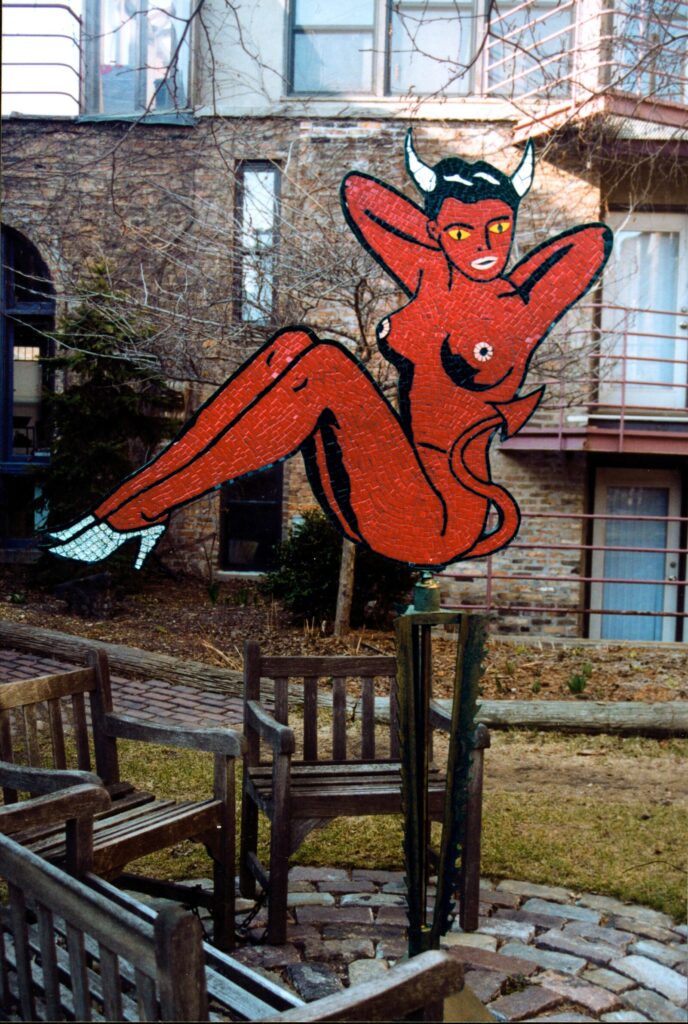
A mosaic wind vane, mounted on a bearing and balanced to turn in a light breeze. Marilyn Houlberg commissioned the piece and read the figure as Pomba Gira, the Brazilian spirit of female sexuality, desire, magic, and self-possession, invoked by women seeking power and autonomy. Where Catholic sanctity is built on purity, Pomba Gira takes the material facts of a life — survival, passion, money, and fierce self-protection — as her territory. The work carries the same red ceramic tile as the Ghede bottle made three years earlier, in a wholly different register. Installed, she wants an air source and a perimeter: the points of her heels are sharp, and the barrier the museum will use is a velvet rope, which is the vocabulary of glamour rather than of caution.

Photograph by Rachael Que Vargas
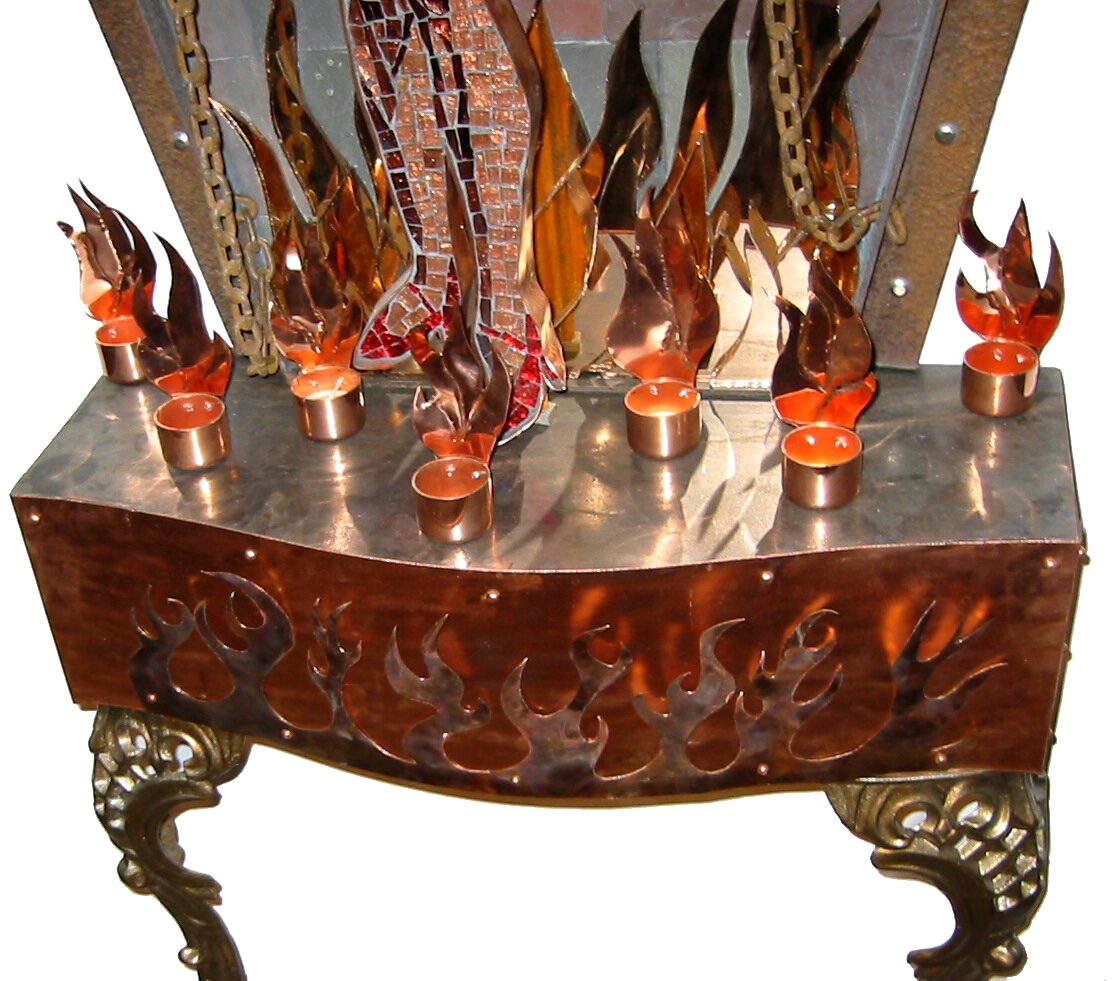
Vitreous glass mosaic, steel, cast iron, slate, antique pink mirror, copper, bronze, with tea candles · 193 × 79 × 25 cm (76 × 31 × 10 in.) · 2004 · Commissioned by Marilyn Houlberg
Anima Sola — the lonely soul — is a Catholic devotional image of a person chained in the flames of Purgatory, appealing to the living for the prayers that will release them. It is a familiar figure across Spain, Latin America, and the Caribbean, printed on candles, prayer cards, and skin. In Haitian Vodou the same figure maps onto Marinette Bwa Chèch, a Lwa of fire, night, iron, and the violence of liberation, said to have been present at the ceremony at Bois Caïman that began the Haitian Revolution. Here she is a glass mosaic nude against a slate wall, chained, standing in copper flames that hold tea candles, with antique pink mirror cut as further flames to catch and scatter the light. The copper flames are worked in repoussé, so no part of their surface is flat. Lit, the candle flicker crosses that irregularity and the copper moves with it. At her feet, beneath the flames, she wears ruby red mirrored heels, the one element of the figure that is neither penitential nor devotional. They are the ruby slippers: worn the whole way, able to end the journey at any point, and not explained to her until the end. Chains and fire are the conditions of her purgatory. The heels are already on her feet.
Photograph by Rachael Que Vargas
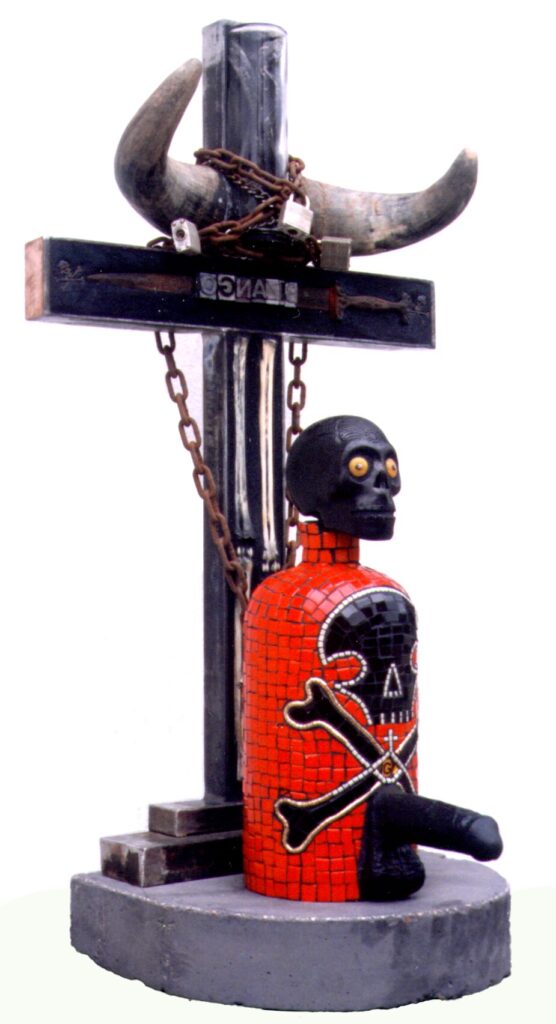
Ceramic tile mosaic over a glass bottle, standing on a concrete base; steel, cast iron, lead type, chain, horn, snake in a jar, brass, bone, and plastic beads · 93 × 47 × 32 cm (36.5 × 18.5 × 12.75 in.) · 1997 · From the collection of Marilyn Houlberg
The Gede are a family of spirits rather than one, and they hold death, sexuality, medicine, and resurrection together. The bottle made for a Gede here is a glass bottle laid over in red tile, carrying a black skull and crossbones on its face and stoppered with a ceramic Día de los Muertos skull whose eyes are beads. On the face of the bottle the skull is outlined in bone beads and the crossbones in brass. A rubber phallus is mounted at the bottle’s foot, in the position the iconography puts it, inseparable from spirits who govern both ends of the biological cycle. Bottle and phallus stand on a concrete base, and that base anchors a cross built from steel C channel, hung with chains that secure a pair of animal horns and a padlock. A broken cast iron dagger crosses the horizontal arm, and a snake preserved in a jar is embedded in the top of the cross. The broken blade, the chains, and the lock follow minkisi logic: power objects assembled to contain and direct force. The bizango cross names the society of the same name, whose work is protection, justice, and the enforcement of a community’s codes. The lead type between the hilt and the point spells BIZANGO backwards, as the type block reads before printing, and comes right in a mirror.

Photograph by Rachael Que Vargas
Vitreous glass, bottle caps, stone, copper, a stone sold as a 15.65-carat emerald, glass eyes, on plywood and cement board · 152 × 91 × 4 cm (60 × 36 × 1.5 in.) · 2017 · Commissioned by the American Museum of Natural History
La Siren is the Haitian Lwa of the sea, of beauty, music, and the deep, and a figure of desire and of danger. The American Museum of Natural History commissioned this third version of her for the traveling exhibition Mythic Creatures: Dragons, Unicorns & Mermaids, and she has been on the road with it since 2017, through nine museums in the United States and Denmark. Her tail is bottle caps, laid from the tip upward in overlapping rows, which is how a Haitian ritual flag lays its sequins and also how a fish carries its scales. Each cap is fixed with a tiny copper brad, set where a drapo sets the seed bead that holds a sequin down. Her hair is silver caps strung on wire, so the strands can be positioned. Her top is red glass set with discs of dyed stone and beads of brass and amber, where the first of the three was topless. She holds a fish across her lap in orange and yellow glass. Its eye is a fragile stone bead, hammered home with a large copper roofing nail chosen to hold the palette, and the bead was likely to shatter under the blow. A stone sold as a 15.65-carat emerald, which arrived from India on the last day the tile could still be moved, sits at her hand.

Photograph by Rachael Que Vargas
Glass seed beads and sequins on cloth, black satin border · 85 × 81 cm (33½ × 32 in.) · acquired 1998–2001
A Gede and a mambo meet across a low altar table, his penis and her vulva exposed, with skulls, crossed bones and grave crosses filling the ground behind them.
The Gede are the spirits of the dead and of the cemetery, and they are equally spirits of sexual license. Obscene speech, the banda, phallic staging and the deliberate scandalising of respectability are what a service for them looks like. Vodou has long made room for people the surrounding culture has not, and some gay men have taken Gede Nibo as a patron of their own.
Roudy Azor works this flag almost entirely in glass seed beads, with sequins kept to a minimum: the dense surface Myrlande Constant brought into drapo around 1990, worked by one of the first men to take it up. He trained in her studio and opened his own at eighteen. It is the only work in this room made by an artist other than Rachael Que Vargas, and the only one made in Haiti.




Photographs of the works by Rachael Que Vargas
The sources are old, public, and not one tradition. Erastes + Eromenos comes from red-figure vase painting of about 500 BCE, which sits in every encyclopedic museum in the world. The Anima Sola is a Catholic devotional image, printed on candles and prayer cards across Spain, Latin America, and the Caribbean; in Haitian Vodou the same figure maps onto Marinette Bwa Chèch. Pomba Gira is Brazilian. The Gede are Haitian, a family of spirits rather than a single one, and Gede Nibo is among them.
Four of the six works reached this collection through Marilyn Houlberg. She taught at the School of the Art Institute of Chicago and was among the foremost scholars of Haitian and African art. She commissioned the wind vane, bought the Anima Sola altar and the Bizango Altar from the artist as each was finished, and collected Gue De-Nibo from Roudy Azor and later sold it to Rachael Que Vargas. She also curated three of the exhibitions in the record below: Creative Inspiration in Port-au-Prince in 1999, Haiti: Vodou Visionaries at Intuit in Chicago in 2001, and Vodou Riche at Columbia College in Chicago in 2007. After her death in 2012 Vargas bought her own three works back from Houlberg’s estate.
Vargas began this work in the early 1990s by reading everything available and by handling objects in galleries and private collections, and Houlberg was the person she brought questions to, tested ideas against, and consulted on the semiotics of materials. What she took from these traditions was the technique and the meaning.
Thus, accumulation and transformation: together these vodoun tendencies give rise to a wider vision, the tchaka or callalloo spirit of salvaging, rebuilding in synthetic layers…there arises a culture of accumulation, with the rare power to digest traits from diverse origins, up to and including those of groups opposed to its own interests.
Beauvoir-Dominique, Rachel. “Underground Realms of Being: Vodoun Magic.” Sacred Arts of Haitian Vodou, edited by Donald J. Cosentino, UCLA Fowler Museum of Cultural History, 1995, p. 166.
Making a body shameful is a way of managing people, and it works. The Sacred Body gathers six works where it failed.
Six works made between 1997 and 2017, in four traditions Western institutions have mostly kept apart. A Greek red-figure scene of two men, cut in marble. A mosaic wind vane that Marilyn Houlberg commissioned from Rachael Que Vargas and then named Pomba Gira, for the Brazilian spirit of desire, survival, and fierce self-protection. An altar for the Anima Sola, the soul chained in the flames of Purgatory, who in Haitian Vodou maps onto Marinette Bwa Chèch. A bizango altar carrying a libation bottle for a Gede. A Haitian sea spirit built for the American Museum of Natural History and shown in nine museums between 2017 and 2025. And Roudy Azor’s Gue De-Nibo, a beaded flag of a ceremony in which a spirit and a mambo stand at an altar with their bodies bared.
Each shows a body in a condition Western institutional culture has used to desacralize it, and each treats that body as the place the sacred happens. It is not a provocation. It is a theological position, and it is older than the discomfort it produces.
Musivum holds this collection because the museum’s argument about mosaic cannot be made anywhere else. Mosaic was kept out of fine art by what it was allowed to carry: floors, borders, pattern, the decorative and the domestic. The body is the subject the hierarchy kept for itself, and a mosaic institution that declined this territory would be conceding the argument it exists to make. Six works, six mosaic materials, running from a stone bought as an emerald to bottle caps and glass seed beads, and neither end of that range carries the subject better than the other.
The register the room brings is one nothing else in the museum reaches. The figures here are not defiant and they are not innocent. They are unembarrassed, and that is the harder thing to depict.
None of these traditions is historical. The Anima Sola is on candles and prayer cards across the Spanish-speaking world now, the Gede are served now, and Pomba Gira is called on now.
The essay below sets out the argument in full.
Six works and six mosaic materials: marble, vitreous glass, red ceramic tile, stone, bottle caps, and glass seed beads. Red ceramic tile does duty twice, on the Ghede bottle in 1997 and on the wind vane three years later, in two registers that have nothing to do with each other.
The constructions are as different as the surfaces. The Ghede bottle is ceramic tile laid over a glass bottle, standing on a concrete base that anchors a cross welded from steel C channel. The wind vane is mosaic on plywood, edged and mounted in steel and copper, balanced on a bearing so a breeze will move it. The Anima Sola altar is glass on a shaped panel against a slate ground, with copper cut into flames, a copper table pierced with more flames, and cast iron legs. The Greek panel is marble set into a frame of 25 × 50 mm steel tube, the same stock that frames the panels of Anatomy Set in Stone.
La Siren III is the work whose making is documented step by step, because it was built in 2017 and photographed as it went. It uses two substrates at once: plywood for the bottle caps, which are nailed, and cement board for the glass, which cannot be adhered to wood. Recessing the caps below the board brings two materials of different thickness to one plane. The caps run from the tail tip upward in rows, each partially flattened with a tack hammer so it overlaps its neighbor, worked in from both edges so the last caps land at the top center.

Fantastic Beasts: A Natural History. Presented by Stephen Fry, BBC One, 27 Feb. 2022.
These works have never been shown together. Each carries its own history, and the record below is per work rather than per exhibit.
| 2006 | The Dirty Show, Tangent Gallery and Hastings Street Ballroom, Detroit, Michigan |
|---|
| 2000 | Fourth Whirl: Whirligigs + Weather Vanes, Fourth World Artisans, Chicago, Illinois |
|---|---|
| 2001 | Around the Coyote, David Leonardis Gallery, Chicago, Illinois |
| 2004 | Annual Invitational Art Exhibition, Jordan River Arts Council, East Jordan, Michigan |
|---|---|
| 2007 | Vodou Riche: Contemporary Haitian Art, Columbia College [C]spaces, Chicago, Illinois |
| 1999 | Creative Inspiration: The Arts of Haitian Vodoun, Musée d’Art Haïtien du Collège Saint-Pierre, Port-au-Prince, Haiti |
|---|---|
| 2001 | Haiti: Vodou Visionaries, Intuit: The Center for Intuitive and Outsider Art, Chicago, Illinois |
| 2017 | Grand Rapids Public Museum, Grand Rapids, Michigan |
|---|---|
| 2018 | Peoria Riverfront Museum, Peoria, Illinois |
| 2019 | COSI, Columbus, Ohio |
| 2019 | The Witte Museum, San Antonio, Texas |
| 2021 | Holstebro Museum, Holstebro, Denmark |
| 2022 | Natural History Museum, Aarhus, Denmark |
| 2023 | Natural History Museum, Miami, Florida |
| 2024 | Museum of the Rockies, Bozeman, Montana |
| 2025 | Museum of Science and Industry, Tampa, Florida |
All nine showings are venues of Mythic Creatures: Dragons, Unicorns & Mermaids, the American Museum of Natural History traveling exhibition.
| Not previously exhibited | Acquired in Chicago between 1998 and 2001 |
|---|
ESSAY
Every body in this room was made profane on purpose. Western institutional culture has spent centuries desacralizing the human body, and each of these six works takes a body that was subjected to that and treats it as sacred. It is not a provocation. It is a theological position, and it is older than the discomfort it produces.
Rachael Que Vargas looked at a pile of marble and saw Attic pottery in it. The stone was the red a Greek vase painter got by leaving the clay bare and the black he got by covering it with slip, and she decided to make a red-figure vase painting out of it in another medium. The picture she chose is explicit: two men, about 500 BCE. She cut, sorted, and set every piece of stone in it, and the panel is Erastes + Eromenos.
Then a massage therapist wanted a work commissioned for a new office. She proposed anatomy, because anatomy is what he works on and because she could already see the stone doing it. Ten years later that proposal had become Anatomy Set in Stone, which the museum holds as a collection of its own.
So a palette put two subjects in front of the same artist that had no other reason to meet: two men in bed, and a body opened on a table. Neither is a stand-in for the other. Both are bodies the culture has agreed to call base, by routes that do not resemble each other. One is desire between men, which was called filth and then made criminal. The other is a corpse worked over as meat so that the mechanism underneath can be drawn, which is about as thorough a desecration as a body undergoes, and which is also a gift: anatomy from dissection moved human health forward permanently, and somebody’s body paid for it.
The palette was chance. What it turned up was true before anybody noticed it.
The most explicit object in this room is where the museum’s anatomy in marble comes from.
There is a notice at the entrance. It says the exhibit contains nudity and sexually explicit imagery, and that it presents religious and ritual works drawn from classical antiquity, Catholic devotional practice, and Afro-diasporic and Haitian Vodou traditions. Every word is accurate, and posting it is ordinary practice. It is also the exhibit’s evidence. A culture that had not made the body shameful would give a museum no reason to put it there.
Desacralize is the verb, and desecration is what it describes. Not censorship, which suppresses a picture, and not repression, which suppresses a desire. Desecration takes a thing out of the category of the holy, reduces it to dirt, and then polices the reduction.
In 1564 the Congregation of the Council of Trent had figures in the Sistine Chapel’s Last Judgment covered as obscene, and the painter given the task of putting the drapery on has been known ever since as Il Braghettone, the breeches-painter. Women were kept out of the drawing, painting, and sculpture classes worked from a nude model, on the stated grounds that they should not be exposed to one, and those classes are what the European academies built their ranking of genres on. What it produced was the line between art and craft, drawn so that the work women were left with fell on the far side of it. The earnings followed the line and still do. Same-sex desire was criminal across most of the Western world within living memory and remains so across much of it. Haitian Vodou was outlawed in Haiti, and its objects were gathered up and burned.
Sexuality is the most efficient lever any of this has, because everybody has a body and nobody can put it down. The work is not done by argument. It is done by diminishment, low and constant and from every direction, until a person accepts that some part of what they are is filth. A person who believes that is easier to govern than somebody who does not. It is not aimed at pictures. It is aimed at the people who will look at them.
Then you walk into the room, and nobody in it has taken any of it on.
The source had none of that done to it.
Red-figure vase painting is candid and it is pleased with itself, and it was not private either, because vase painting went onto objects people used at table. The picture this panel is cut from was made to be handled at a party, in a house, in front of everybody, by people drinking out of it.
Nobody in it is being brave. They were never relieved of anything. What a viewer feels standing in front of the panel arrived later, and it can be dated.
Marilyn Houlberg commissioned a mosaic wind vane, and when it was finished she looked at the horned woman on the bearing and said Pomba Gira: the Brazilian spirit of desire, survival, money, magic, and fierce self-protection, invoked by women who want power and autonomy. A scholar of Haitian and African religion had recognized somebody. That reading is now the work’s title.
Sanctity in the Catholic register is underwritten by purity, and a saint who loses it loses the standing with it. Pomba Gira carries no such clause. She governs appetite, money, and self-defense, and none of it is held against her, which is the whole reason women call on her. In a theology built that way there is nothing to desecrate. There is no purity to withdraw.
The work behaves like the spirit. She is balanced on a bearing, a light breeze moves her, and she has been turning since 2000. A pin-up is a picture that holds still on a wall and stays available; this one is finished on both faces and shows you her back whenever the wind decides. She is also an instrument, and what a vane is for is telling you which way things are going.
In the gallery a vintage pedestal fan turns her through opening hours. The proverb says people in hell want ice water. She has a fan. The points of her heels are sharp enough to need a barrier, and the barrier is a velvet rope, which is the vocabulary of glamour rather than of caution, and which draws a line she sets rather than one drawn around her.
The Anima Sola, the lonely soul, is a Catholic devotional image: a soul chained in the flames of Purgatory, appealing to the living for the prayers that will release her. She is printed on candles and prayer cards and inked on skin across Spain, Latin America, and the Caribbean, and a visitor who has lit a candle to her walks up to this altar already knowing what it is for. In Haitian Vodou the same figure maps onto Marinette Bwa Chèch, a Lwa of fire, night, and iron, said to have been present at the ceremony at Bois Caïman that began the Haitian Revolution.
Purgatory is a machine for producing humiliation. That is the whole mechanism: torment with no exit, and a soul who has to ask other people to get her one. It is the hardest test in the room, and it is not working. Her arms are up and her back is straight, and at her feet, under the fire, she is wearing ruby red mirrored heels.
They are Dorothy’s slippers, worn the whole way and able to end the journey at any point. In the story somebody eventually tells Dorothy. Here there is nobody in the picture to tell her. The devotional mechanism has her waiting on prayers from other people, which is the slow route and the unreliable one, and the fast one is already on her feet. Using it requires nothing more than working out that it is hers.
The temptation is to call what she has pride, and pride is the wrong word. Pride is comparative. It needs somebody to be better than, and it turns into humiliation the moment things go badly, because it was never holding anything up from the inside. What this figure has is self-esteem, and the root of that word is self. It does not poll the room.
The Gede are a family of spirits rather than one spirit. They hold the dead and the cemetery, and they hold appetite, medicine, and resurrection along with them. They arrive at funerals in dark glasses, say what everybody else is too polite to say, and dance the banda, which is not a subtle dance.
That behavior is the behavior of somebody with nothing left that can be taken. Shame needs a future to work on, and the Gede are past the end of theirs. This is where the composure in this room comes from, and it is not innocence. It is the opposite of innocence.
Two works here belong to them. The rubber phallus at the foot of the bottle in Bizango Altar with Ghede Libation Bottle is an attribute rather than a provocation, inseparable from a spirit who governs both ends of the biological cycle. The chains, the padlock, and the broken dagger follow minkisi logic, which assembles power objects to contain and direct force. The bizango society the cross is named for governed the Haitian countryside for long stretches and enforced its own justice.
Between the hilt and the point of the broken blade the word BIZANGO is set in lead letterpress type, reversed, the way a type block reads before printing. It comes right in a mirror. To read it, a visitor has to work out that the line was not addressed to them.
In 1999 the altar was shown in Port-au-Prince, at the Musée d’Art Haïtien du Collège Saint-Pierre, in an exhibition of the arts of Haitian Vodou.
La Siren is the Lwa of the sea, of beauty, music, and the deep, and a figure of desire and of danger. The American Museum of Natural History commissioned the third of the La Siren mosaics in 2017 for a traveling exhibition, and from 2017 to 2025 she was shown in nine museums in the United States and Denmark.
Her tail is bottle caps, laid from the tip upward in overlapping rows, each one fixed with a small copper brad set exactly where a Haitian flag sets the seed bead that holds a sequin down. A stone sold as a 15.65-carat emerald, which arrived from India on the last day the tile could still be moved, sits at her hand.
Mosaic is dirt. Stone cut into cubes, clay fired into tile, sand melted into glass. It is the most literally earthy material a picture can be made from, and it has carried the sacred on the walls and vaults of churches since late antiquity, because that move, taking the lowest material available and making it holy, is the thing the medium knows how to do.
Then the hierarchy of fine art was drawn up and mosaic went to the floor, with the decorative and the domestic. Not for anything it could not do. For what it was made of, and for what it was allowed to carry.
The medium and the subject were demoted by the same reasoning, and this room puts them back together. Six works and six mosaic materials: marble that came out of the ground already red and already black, vitreous glass set around a woman standing in fire, red ceramic tile for a Gede bottle in 1997 and again for a wind vane in 2000, bottle caps, and glass seed beads. A bottle cap and a stone bought as an emerald are in this room carrying the same subject, and neither is carrying it better.
None of it is done for shock. What the room argues for is autonomy, authenticity, and, against everything the phrase usually means, self-control: the judgment about a body kept inside the person who has to live in it.
Both figures in Roudy Azor’s Gue De-Nibo are on their feet, close, moving, at an altar laid with food and lit candles. Both are dressed. His penis is out through the zipper of his pants and her vulva is bare below her top. Whether what follows is sex is not settled by the picture and does not need to be.
That is not a nude. The nude is a Western category and it runs the other way: a body is undressed, arranged, and offered up to be looked at, and the European academies built a ranking of genres on top of it. Nobody in Azor’s flag has been undressed. They are mid-ceremony, clothed, with their sex showing.
Drapo open a ceremony. They are carried in procession and they salute the lwa, announcing the spirits ahead of everything that follows, and what they announce is arrival. A spirit comes by mounting a practitioner, who gives the body over to it. So the body is not the obstacle standing in front of the sacred. It is the instrument the sacred is played on.
The flag hangs last, beside the door, because the gallery on the other side of that wall holds nine more of them. The museum’s route reaches this room out of five millennia of religious mosaic, by way of a room of Kongo grave monuments, and leaves it through a room whose whole subject is a spirit coming into a body. The sequence runs through the body rather than around it.
Not one figure in this room is looking out to see how it went over. That is the thing that was supposed to have been taken from them, and it is what is standing in the room.
Brown, Karen McCarthy. “Serving the Spirits: The Ritual Economy of Haitian Vodou.” Sacred Arts of Haitian Vodou, edited by Donald J. Cosentino, UCLA Fowler Museum of Cultural History, 1995.
Cosentino, Donald J., editor. Sacred Arts of Haitian Vodou. UCLA Fowler Museum of Cultural History, 1995.
MacGaffey, Wyatt. “The Eyes of Understanding: Kongo Minkisi.” Astonishment and Power, Smithsonian Institution Press for the National Museum of African Art, 1993.
Métraux, Alfred. Voodoo in Haiti. 1959; English translation, 1972.
Polk, Patrick A. Haitian Vodou Flags. Jackson: University Press of Mississippi, 1997.
Vatican Museums. “The Last Judgement.” Sistine Chapel, Collections, museivaticani.va. Accessed 29 Aug. 2026.