
COLLECTION
Fourteen concrete grave monuments, each with an antique radio set into the stone, and each named for a subject rather than a person: Wealth, Justice, Love, Safe Travel, Second Sight. Commissioned by the Tarble Arts Center in 2000, Radio Ancestrale is a room built at the crossroads, where the living and the dead stay within speaking distance.

Radio Ancestrale installed at the Tarble Arts Center, Eastern Illinois University, 2000. The painted vévé walls that enclosed the monuments were dismantled afterward, and the restaged installation stands without them.
The installation returns to the public in the museum’s first pop-up exhibition, with a new score recorded in the host city.
| Monuments | Fourteen |
|---|---|
| Date | 2000 |
| Commission | Tarble Arts Center, Eastern Illinois University |
| Materials | Concrete over a wire-wrapped wooden armature, antique radios, and embedded found objects |
| Dimensions | Width × depth × height; 48 to 241 cm wide, 58 to 196 cm high (19 to 95 in., 23 to 77 in.) |
| Weight | 23 to 36 kg each (50 to 80 lb) |
| Sound | A score plays through the monuments, recorded anew with children and elders in each host city |
| Admission | Included in general admission |
Fourteen hollow concrete grave markers, each set with an antique radio and embedded with objects chosen for what they mean. Each names a subject rather than a person. The questions under each stone are somewhere to begin; yours will be different.

Installation view, Tarble Arts Center, 2000.
51 × 41 × 61 cm (20 × 16 × 24 in.) · 2000
What makes someone beautiful? Did you like how you looked? Should I care about this as much as I do? Does it matter less when you get older?

Installation view, Tarble Arts Center, 2000.
84 cm per side × 112 cm high, triangular base (33 × 44 in.) · 2000
How do you know when something is about to go wrong? Did you ever know something before it happened? If I know something bad, should I say it? Is it better not to know?

Installation view, Tarble Arts Center, 2000.
61 × 64 × 97–99 cm (24 × 25 × 38–39 in.) · 2000
Have you ever been lucky? Can you make your own? Did your luck ever turn on you? How do you know when to stop pushing it?

Installation view, Tarble Arts Center, 2000.
51 × 41 × 71 cm (20 × 16 × 28 in.) · 2000
What made you strong? Who did you have to be strong for? Does it get easier? When should I give in instead?
Installation view, Tarble Arts Center, 2000.
81 × 71 × 109 cm (32 × 28 × 43 in.) · 2000
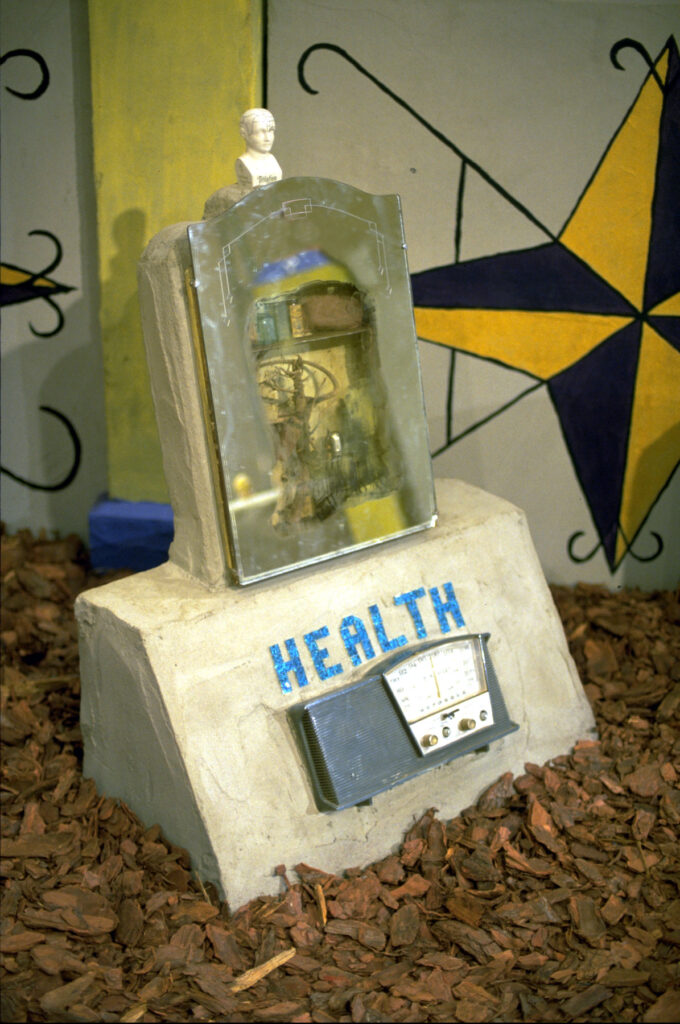
What do you do when the doctors have nothing? What did your family use before there were doctors? How do you sit with someone who is sick? How do you stop being frightened?

Studio photograph, 2000.
48 × 38 × 58 cm (19 × 15 × 23 in.) · 2000
How much is enough? Were you ever poor? Did money change anyone in our family? What do you wish you had spent it on?

Installation view, Tarble Arts Center, 2000.
86 × 46 × 196 cm (34 × 18 × 77 in.) · 2000
How do I find the right person? How did you know? Is it supposed to hurt? What do you do when it ends?

Studio photograph, 2000.
48 × 46 × 74 cm (19 × 18 × 29 in.) · 2000
How do you find work? What do you do while you are looking? Did you like what you did? What did you do when there wasn’t any?

Installation view, Tarble Arts Center, 2000.
66 × 51 × 86 cm (26 × 20 × 34 in.) · 2000
How do people stay together? What did you forgive? What could you not forgive? Were you ever tempted?

Installation view, Tarble Arts Center, 2000.
241 × 51 × 188 cm (95 × 20 × 74 in.) · 2000
Why is this unfair? What do you do when nobody will help? Was anything ever put right for you? Is forgiving the same as letting go?

Studio photograph, 2000.
48 × 41 × 69 cm (19 × 16 × 27 in.) · 2000
What were you afraid of? Who protected you? How do you keep a family safe? What could you not keep safe?

Installation view, Tarble Arts Center, 2000.
48 × 30 × 74 cm (19 × 12 × 29 in.) · 2000
How do you leave home? What did you take with you? What did you lose on the way? How do you know when to come back?

Studio photograph, 2000.
48 × 41 × 61 cm (19 × 16 × 24 in.) · 2000
Where do I start? How did you know which way to go? Who opened a door for you? What do you do when every way is shut?

Installation view, Tarble Arts Center, 2000.
53 × 48 × 70 cm (21 × 19 × 27.5 in.) · 2000
What do you know now that you didn’t at twenty? Who taught you? What were you wrong about? What do you want me to remember?
Radio Ancestrale began with a photograph. In Robert Farris Thompson’s Face of the Gods, a cast concrete grave marker in southern Florida carries a radio set directly into the concrete, a channel open to the land of the dead. Rachael Que Vargas read it as a room — a space full of tombstones with radios, all playing at once, pulled from different parts of the spectrum and fading in and out of static, music, and speech. The marker belongs to a tradition Thompson had described ten years earlier.
Nowhere is Kongo Angola influence on the New World more pronounced, more profound, than in black traditional cemeteries throughout the South of the United States. The nature of the objects that decorate the graves there, as well as in places as diverse as Haiti and Guadeloupe in the West Indies, reveals a strong continuity. That continuity might be characterized as a reinstatement of the Kongo notion of the tomb as a charm for the persistence of the spirit.
Thompson, Robert Farris. Flash of the Spirit: African and Afro-American Art and Philosophy. Random House, 1983.
The reading behind the work was already a decade deep. Vargas came to Kongo material through Wyatt MacGaffey’s Astonishment and Power, which opened an inquiry into minkisi that has run through her work ever since. Minkisi are power objects, and MacGaffey describes one as a kind of portable grave, holding a spirit personality brought back from the land of the dead. In BaKongo terms all exceptional power originates in some form of communication with the dead, which makes the grave an altar. Radio Ancestrale takes that literally: fourteen graves, each fitted with a working channel, each loaded with matter chosen to do a job.
The choice of matter is the older principle, and Vargas has named its source for thirty years. In minkisi the active ingredient is selected because its appearance suggests the effect wanted, or because its name puns toward the outcome — a grain called lubizu for zibula, that it may open. Every monument here is built that way. Cowrie shells for money, because cowries were money. A clock radio on the stone named Beauty. Skeleton keys on the stone named Open the Way. The same principle later selected marble for the color it already carried, and produced Anatomy Set in Stone.
The knowledge behind it was acquired rather than borrowed. Alongside the reading came objects handled in galleries and private collections, and the counsel of Marilyn Houlberg, a scholar of Haitian and African art who became a mentor and a collector of the work, and the person Vargas brought her questions to and tested her readings against. By 2000 the practice had been working inside the material for a decade.
MacGaffey, Wyatt. “The Eyes of Understanding: Kongo Minkisi.” Astonishment and Power, Smithsonian Institution Press for the National Museum of African Art, 1993.
Thompson, Robert Farris. Face of the Gods: Art and Altars of Africa and the African Americas. Museum for African Art, and Prestel, 1993.
A grave usually marks where a relationship ended. Radio Ancestrale treats it as the place the relationship is conducted, and gives it an open channel.
The fourteen markers name no dead. They name Wealth, Justice, Fidelity, Health, Strength, Safe Travel, Open the Way, Luck, Protection, Second Sight, Wisdom, Steady Work, Love, and Beauty: subjects rather than people, and the fourteen things a person most needs to talk to somebody older about. A grave with a name on it belongs to someone else. A grave that says Steady Work is somewhere to stand and ask what to do about work.
Every stone argues its case in matter. The objects set into the concrete are chosen because they look like the outcome or pun toward it, which is the selection logic of Kongo minkisi carried into a university gallery in central Illinois. The reasoning is legible without instruction: cowrie shells were currency, a safe deposit door protects, an alarm clock gets a person to work. The stones can be read by a visitor who has never heard of the Lwa, and they hold more for a visitor who has.
Radio Ancestrale is made after these traditions rather than in imitation of them, and Vargas set that standard for herself in writing before the work was built. The artist statement she submitted when the Tarble Arts Center commissioned it says what she was working to: she strove for authenticity in materials and techniques of construction, while considering that tradition is strongest when it incorporates the present day. A copy would have been the failure.
Musivum holds Radio Ancestrale because it is a mosaic environment in the literal sense: discrete components individually set and fixed into a surface, lifted off the flat plane and into the round, and assembled into a space a visitor walks through. Cowrie shells spell Wealth. Red tile spells Love and builds the pierced heart on its face. Shards of antique mirror spell Beauty, Luck, and Wisdom, one of them scratched in reverse. The medium is doing the work this museum was built to show it can do.
It also brings the collection a register the rest of it does not reach. Grief, longing, and continuance. The work takes death seriously as an ongoing relationship rather than a terminus, holds grief and beauty at the same time, and does it in a room a person can walk into.
The work is a communication device rather than a petition. A petition is a transaction; a question is a conversation, and Radio Ancestrale was built for the second. Vargas has kept a rule since childhood that she asks the gods for nothing — the only question she thinks worth putting to them is what can be done for them — and what stands here is that same relation extended to people who do not share it: access to the wisdom of their forebears, and a room in which to ask for it.
The essay below sets out the argument in full.
Each monument is built on a hollow armature wrapped in chicken wire, with concrete applied to the surface by hand. That is why stones which read as immovable weigh between twenty-three and thirty-six kilos and travel readily: Justice comes apart for transport, and Love packs into a cube of forty-eight centimetres. The weathering is stagecraft.
Everything embedded in the stones is a found object, which does not mean unpurchased. It means whatever could be found at hand. The radios were bought, none of them for more than twenty dollars, and some of the charms were bought; much of the rest was simply come across. What any one marker could say was bounded by what turned up inside the build period or was already on the shelf. Six were made first and share a single form, built quickly as proof of concept for the commission.
Objects are set into the faces and bases, and the surfaces built up in the manner of a memory vessel — the African American memorial form made by fixing a dead person’s possessions to a jar or a jug, so that the container holds the spirit. Lettering is set from cowrie shells, red tile, and shards of antique mirror, one of them cut in reverse.
A wall painted with vévés enclosed the installation in 2000, the ritual inscriptions that call the Lwa, laid out by the system rather than by the composition: Legba at the gate, the Minokan vévé along both side walls, the Ghede closing the far end. The wall was dismantled afterward, and its material went into the flotation for a thirty-foot fire-breathing dragon boat on the Chicago River.
The score is the part of the work that is remade. The 2000 score has been retired, and each staging generates its own: recording sessions run through local schools and elder care organizations, children asking the questions they most want answered on a stone’s subject and elders answering with what they know. Call and response, which is the oldest structure in the traditions the work comes out of. All fourteen radios play at once and low, love and loss and rights and wrongs overlapping until it stops being a set of statements and becomes a condition, running like the sound of the sea. The recordings stay with the city that made them, and the stones are reinvested wherever the work travels, which is what the tradition they come from asks of a vessel.
The speakers inside the stones were originally wired, and the wiring ran across the floor. The restaged installation replaces them with wireless units, which removes the tangle and the hazard together. Because the monuments are hollow, the swap is straightforward.
The stones have been in storage since 2000. What wear they carry reads as age, which is what a grave monument is supposed to have.
Cover feature. Charleston Times-Courier, Spotlight Arts and Entertainment, Charleston, IL, 12–18 Feb. 2000, p. 1.
“Artist John Unger to Talk About Graveyard Sculpture Installation.” Charleston Times-Courier, Charleston, IL, 12 Feb. 2000, p. C9.
| Year | Venue | Works shown |
|---|---|---|
| 2000 | Tarble Arts Center, Eastern Illinois University, Charleston, Illinois | The complete installation: fourteen monuments, the painted vévé walls, and the original score. 21 January – 5 March |
ESSAY
Fourteen concrete grave markers, each with a radio set into it, name subjects rather than the dead. Radio Ancestrale was built as a communication device, and what it carries is questions rather than requests.
A cemetery with nobody in it.
Fourteen markers stand on bark mulch, each with an antique radio set into the concrete, and not one of them carries a name. They carry Wealth, Justice, Fidelity, Health, Strength, Safe Travel, Open the Way, Luck, Protection, Second Sight, Wisdom, Steady Work, Love, and Beauty.
Those are not requests. They are subjects: the fourteen things a person most needs to talk to somebody older about.
A grave with a name on it belongs to someone else. A grave that says Steady Work is somewhere to stand and ask what to do about work. The room is a communication device, and the visitor supplies one half of the conversation.
Radio Ancestrale began with a photograph. In Robert Farris Thompson’s Face of the Gods, a cast concrete grave marker in southern Florida carries a radio set directly into the concrete, a channel open to the land of the dead. Rachael Que Vargas found it in a Chicago bookstore at night and read it as a room: a space full of tombstones with radios, all playing at once, pulled from different parts of the spectrum and fading in and out of static, music, and speech. The Tarble Arts Center at Eastern Illinois University commissioned it, and it stood from 21 January to 5 March 2000.
A white American artist builds a graveyard out of Kongo cosmology and Haitian ritual inscription. Whatever the quality of the object, the charge is extraction: the visual language of a tradition lifted without its internal logic, producing decoration rather than argument.
The answer is not that the work stayed close to its sources. It is that staying close would have been the failure.
Vargas set her own standard in writing, before the work was built and before anyone had occasion to challenge it. The artist statement she submitted when the Tarble Arts Center commissioned Radio Ancestrale says what she was working to: she strove for authenticity in materials and techniques of construction, while considering that tradition is strongest when it incorporates the present day. A faithful reproduction of a nkisi would have satisfied the first half of that and abandoned the second, and it would have produced a souvenir and a trespass at the same time.
She had been at this since the winter of 1987, when she was twenty. It began with Robert Johnson and with the Legba figure in the film Crossroads, which is to say it began a long way from the source and took years to arrive. Wyatt MacGaffey’s Astonishment and Power came next and sent her into Kongo material for the rest of the decade. She read to the ground, handled objects in galleries and private collections, and talked to specialists constantly. Marilyn Houlberg became a mentor: the person she brought questions to, tested ideas against, and asked about the parallels and patterns she thought she could see, and who advised her on the semiotics of an object, a color, a way of encoding an idea in physical material.
Radio Ancestrale is made after these traditions rather than in imitation of them. It carries as much of the vocabulary and the grammar as Vargas could learn, and it is trying to be something else.
In minkisi the active ingredient of a power object is chosen because its appearance suggests the effect wanted, or because its name puns toward the outcome. A grain called lubizu stands for zibula, that it may open. The object is not a symbol of the result. It is an argument for it, made in matter.
Every stone in Radio Ancestrale is built that way, and the reasoning is legible without instruction. Cowrie shells spell Wealth because cowries were money. Skeleton keys cover the face of Open the Way. A safe deposit door is set into Protection, and the locks are scattered across the whole face at every angle. On Fidelity the tuning dials are naval buttons stamped with anchors, holding the couple to the house, and the wedding figurine is a naval man.
The puns run deeper than the obvious ones. Fidelity’s radio is an Admiral, in pink — a masculine brand name in a feminine color, which is a joke about the compromises a marriage runs on, and it is also a clock radio, so it says the same thing as the little mantel clock standing on the hearth above it. Beauty’s radio is the kind that would have sat on a dressing table, and it too is a clock: the stone grants the wish and starts a timer on it. Justice’s radio has columns on the case and reads as courthouse architecture. Health’s is teal, the color used in hospital design for the same reason it is used here.
Which is the part worth pausing on. The channel itself is made of puns. Thompson’s Florida marker put a radio in a grave because a radio receives voices from somewhere you cannot see. Vargas took that and went further: not one radio but fourteen, each chosen for what its color or its brand or the shape of its cabinet could be made to say. Safe Travel’s set has the word Traveler printed on it and small airplane propellers glued to its dials. Second Sight’s has metal fortune-teller heads fixed to its corners.
A mass-produced consumer appliance is close to the least sacred object available in the twentieth century. Fourteen of them are doing the work of altars. That is the fresh thing the work sets out to do, and it is not a decoration on top of the borrowed logic. It is the borrowed logic, extended.
The same principle turns up twenty-five years later in Anatomy Set in Stone, where the founding observation is that stone comes out of the ground in the colors of the interior of the human body, and the rule that follows is that no stone may be dyed. Matter chosen for what it already is, rather than for what it can be made to represent, is the oldest working principle Vargas has. Radio Ancestrale is where it is most literal.
Vargas has kept a rule since childhood: she does not ask the gods for anything. She has held to it in circumstances where most people would have made an exception, including the imminent prospect of her own death. Her reasoning is short. They gave us life and a whole world; the only question worth putting to them is what we might do for them.
She then built fourteen monuments that are nothing but asking, which she finds funny, and which turns out not to be a contradiction at all.
A petition is a transaction. A question is a conversation. Radio Ancestrale is not a machine for requesting outcomes. It is a machine for receiving counsel, and that distinction is the whole design. Nobody standing at these stones is asking to be given wealth. They are asking what to do about money.
Which is exactly the relation Vargas has to the divine. She does not petition; she converses. The one question she thinks worth putting is itself a question rather than a request. So the room is not a hostess accommodating a practice she declines — it is her own practice, extended to people who do not share it, offering them the part of it she thinks is worth having: access to the wisdom of their forebears.
That explains the decision that organizes everything else. A memorial cemetery names the dead and invites the living to grieve at a distance. This one names the subjects and leaves the graves unoccupied, which turns every marker into a place a visitor can stand and speak. The work is furnished rather than authored. It is set out for use.
It also explains a silence. There is no instruction here on what to believe or whom to address. Vargas regards proselytizing as the highest sin, because it disrespects a person’s existing relationships with their own divine providers, and the corollary of never asking the gods for things is never telling anyone which gods to deal with. The room is available. What a visitor does in it is the visitor’s business.
The fourteen stood inside a wall painted with vévés, the ritual inscriptions that call the Lwa, and the placement followed the system rather than the composition.
Legba was drawn on both sides of the gate, because Legba holds the crossroads and is addressed before any other. The Minokan vévé, which summons the Lwa collectively, ran along both side walls. The vévé of the Ghede — Baron Lacroix, Baron Cimetière, and Baron Samedi, who hold death and the cemetery — closed the far end, because a cemetery is theirs. Vargas laid it out, in her account, to give level ground and keep clear of turf disputes.
That is a hostess again, seating the guests correctly.
The walls did not survive. They were dismantled after the exhibition and their material went into the flotation for a thirty-foot fire-breathing dragon boat on the Chicago River, which is its own kind of afterlife. The stones survived intact.
So did the third element, in a form that has changed. In 2000 a fifteen-minute score played through the monuments in a loop, composed at Engine Studios from digital samples, analog field recordings, and live instrumentation, improvised live and then composited, and organized around radio static as the sound of the space between the living and the dead. That score has been retired.
What replaces it is not a substitute. Each city that hosts the work now records its own: children asking the questions they most want answered on a stone’s subject — how do I find the right partner, why is this unfair — and elders answering with what they know. Call and response, which is the oldest structure in the traditions this work comes out of.
All fourteen radios play at once and low. Love, loss, rights and wrongs, the whole mess of human feeling and bewilderment, overlapping until it stops being a set of statements and becomes a condition: the buzz of family and community and the world, running like the sound of the sea.
The tradition supports this more directly than a preservation instinct would. A vessel requires periodic reinvestment with living spirit to remain active; a fixed one goes quiet. The 2000 score held the installation at a single moment and a single sensibility. The replacement makes it perpetually renewable, and it hands the content of the work to the community standing in front of it. Vargas does not supply the voices either.
The commission had a purpose beyond the gallery, and the record of it is a letter.
Radio Ancestrale was presented in conjunction with the university’s annual Junior/Senior High Enrichment program, which existed to bring secondary students from small rural communities into contact with contemporary art, with particular emphasis on content and non-traditional media. Around 250 students and their teachers came through, from schools across seven counties of east-central Illinois. Docents led tour groups through the installation and connected it to other artists working from multicultural aesthetics. Vargas gave a public talk on the sources, the materials and techniques, the iconography and where it sat in the history of African-based religions, and the musical and literary influences on the score.
Then the students went into the studio and made their own.
The project set for them was to use found objects, in a shadow box format, to make a visual message. Which is to say that the first staging of Radio Ancestrale ended with two hundred and fifty teenagers assembling objects into arguments, exactly as the fourteen stones do.
Kit Morice, the Tarble’s Curator of Education, and Michael Watts, its Director, wrote that the installation “provided the perfect springboard” for that year’s program and was “extremely well received by teachers and students alike,” and recommended it to other institutions. That is a solicited letter and it reads like one. The part that is not solicited is the program itself, and what the program tells us: the work’s first public life was already participatory, and the audience it was built to reach was rural teenagers who had not previously encountered anything like it.
The community recordings are therefore not a new direction. They complete something the installation did on its first outing and then lost when the score was fixed.
Radio Ancestrale enters the collection of a museum being built in Spain, and Spain is not a distant context for it.
The embedded-object logic has a living cognate there. The exvoto tradition — objects fixed to a wall as petitions to a saint, the altar as accumulation — is alive in Spanish popular religious practice in a way it is not in the American Midwest. Pilgrimage church walls hung with crutches, photographs, and votive offerings are a common sight. A Spanish visitor meets these fourteen stones already knowing what it means to fix an object to a surface and mean something by it. The cosmological structure will not be foreign. It will be a version of something familiar, refracted through unfamiliar sources.
There is a second connection and it is less comfortable. The traditions the work draws on exist in the Americas because of the Atlantic slave trade, and Spain’s role in that trade is the hinge through which they travelled. A Spanish audience does not encounter this work as exotic Americana. They encounter something their own history produced and then largely forgot.
That is a more charged reception than a university gallery in central Illinois, and a more interesting one.
The work was made in 2000 by a person who no longer exists in the form that made it.
Vargas was young, male, white, middle class, from a monoculture region, operating from a position of privilege she had not examined and did not then understand. She says so herself, and more bluntly than a museum would put it. She has since written the standards this institution holds its own writing to, and her prose from that period does not meet them.
Three things can come apart here, and keeping them apart is the only honest way through. The text from that period fails. The position it was written from holds up less well than she would like. The work holds.
That is not a comfortable finding but it is a real one, and it is not unusual: a rigorous method can be run from an unexamined place and still produce something that stands. The research was real. The objects were handled, the scholarship was read, the corrections were taken. What was missing was not knowledge of the traditions.
The strongest evidence about the work comes from outside it, and it is a fact rather than an interpretation. A Ghede libation bottle of Vargas’s was chosen by Saveur St. Cyr, a Haitian houngan visiting Marilyn Houlberg in Chicago, from among some thirty traditional bottles on Houlberg’s altar, and used in ritual. He chose it without knowing who had made it. A practitioner of a living tradition, offered thirty objects made inside that tradition and one made outside it, selected the outsider’s blind.
That is a verdict the tradition rendered on its own terms, and it asks nothing of a reader who does not share its beliefs.
The stones are in storage and about to be crated. The walls are gone. The score is remade in every city that takes the work.
What survives is a room designed to be reinhabited — fourteen ordinary human subjects, wired for reception, and left open for whoever walks in. The young ask and the old answer, in a graveyard, through radios. There is nothing in that a Kongo cosmology would find strange, and nothing in it a visitor needs a cosmology to use. The artist who built it will not ask for any of it on her own behalf. She has said what her job is, and it has not changed in twenty-five years: to live at the crossroads and reveal the mysteries to those with an appetite for them.
The fourteen stones are that appetite, anticipated and provided for.
MacGaffey, Wyatt. “The Eyes of Understanding: Kongo Minkisi.” Astonishment and Power, Smithsonian Institution Press for the National Museum of African Art, 1993.
Morice, Kit, and Michael Watts. Letter of recommendation for Radio Ancestrale. Tarble Arts Center, Eastern Illinois University, 2000. Unpublished.
Thompson, Robert Farris. Face of the Gods: Art and Altars of Africa and the African Americas. Museum for African Art, and Prestel, 1993.
Thompson, Robert Farris. Flash of the Spirit: African and Afro-American Art and Philosophy. Random House, 1983.