
COLLECTION
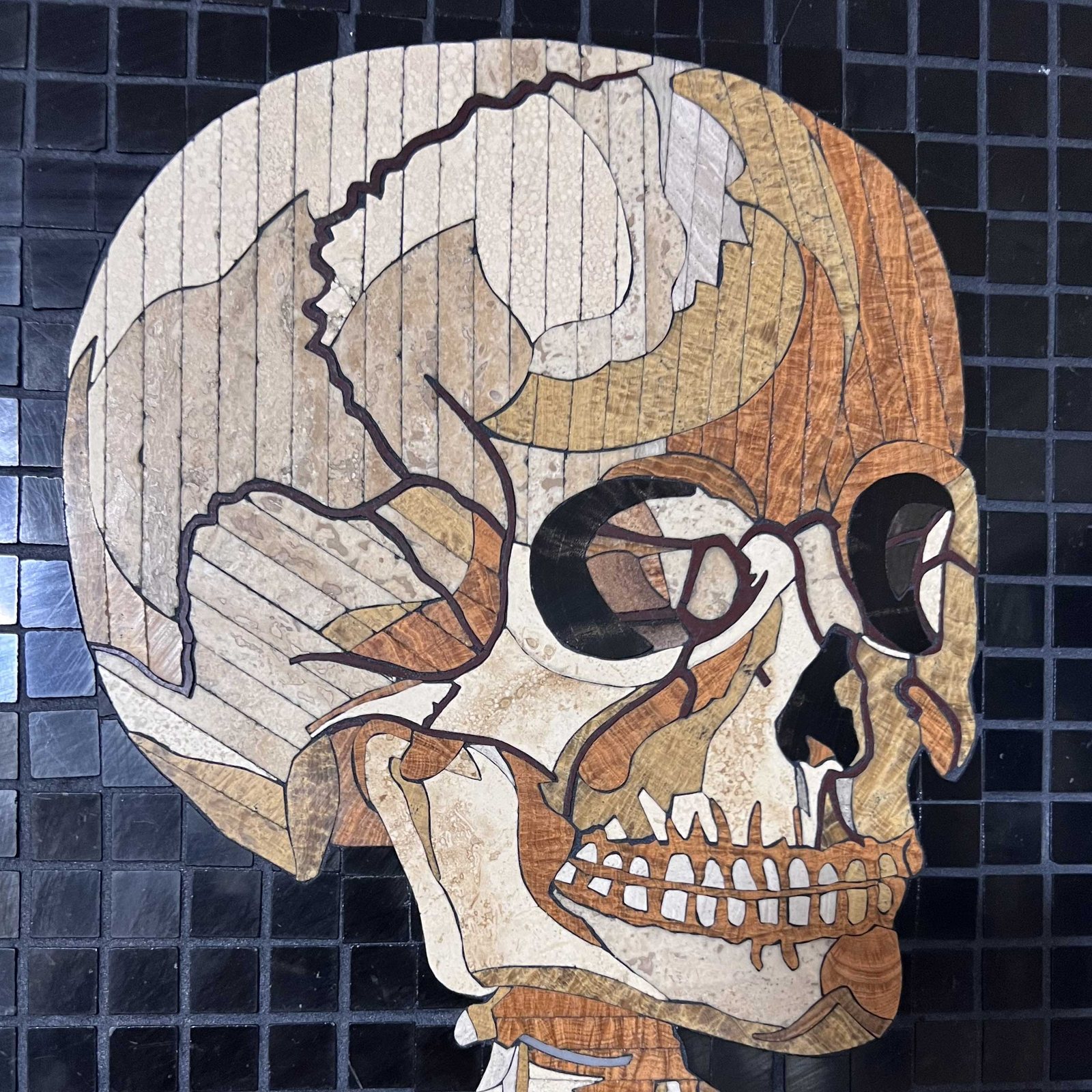
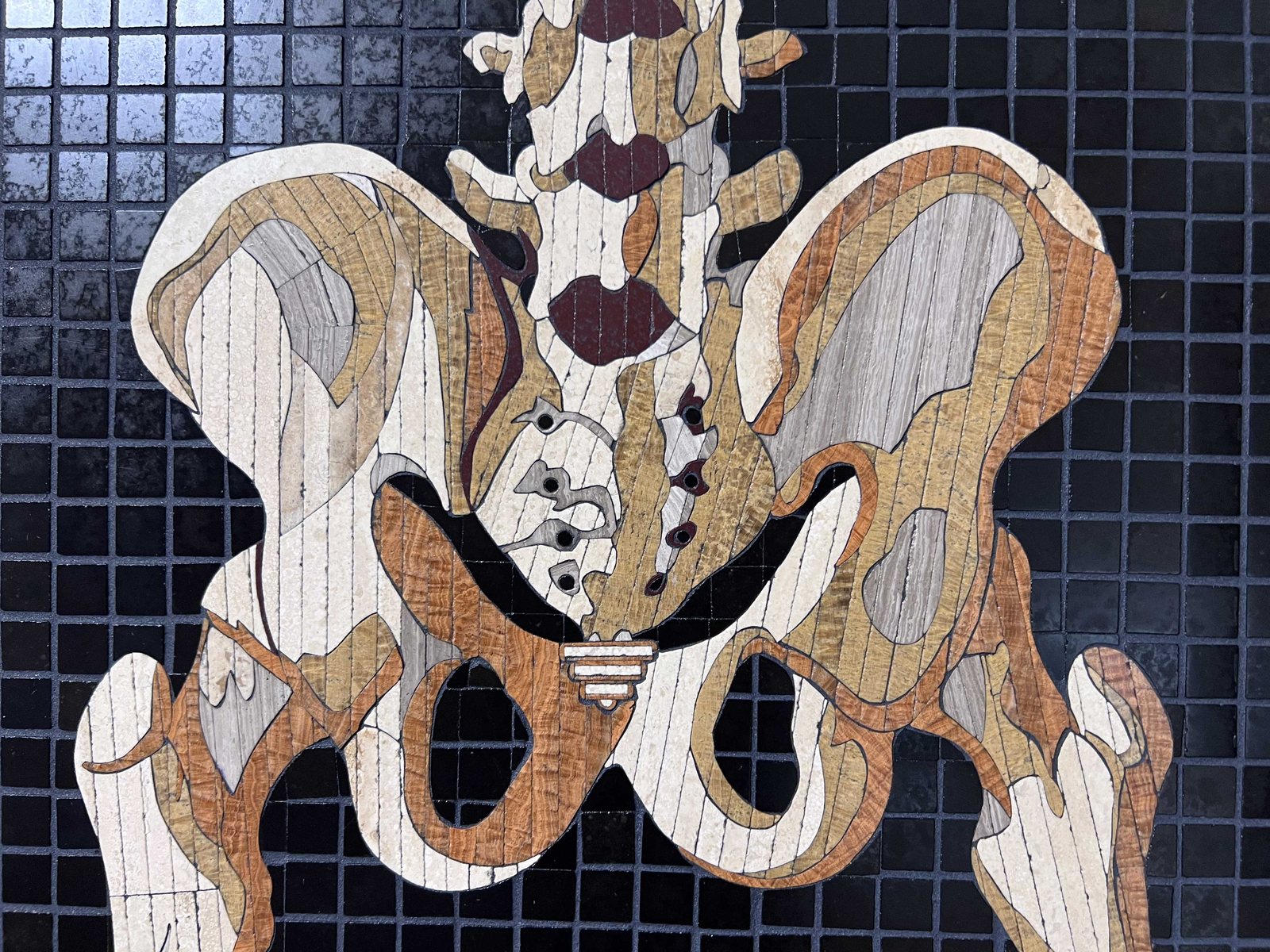
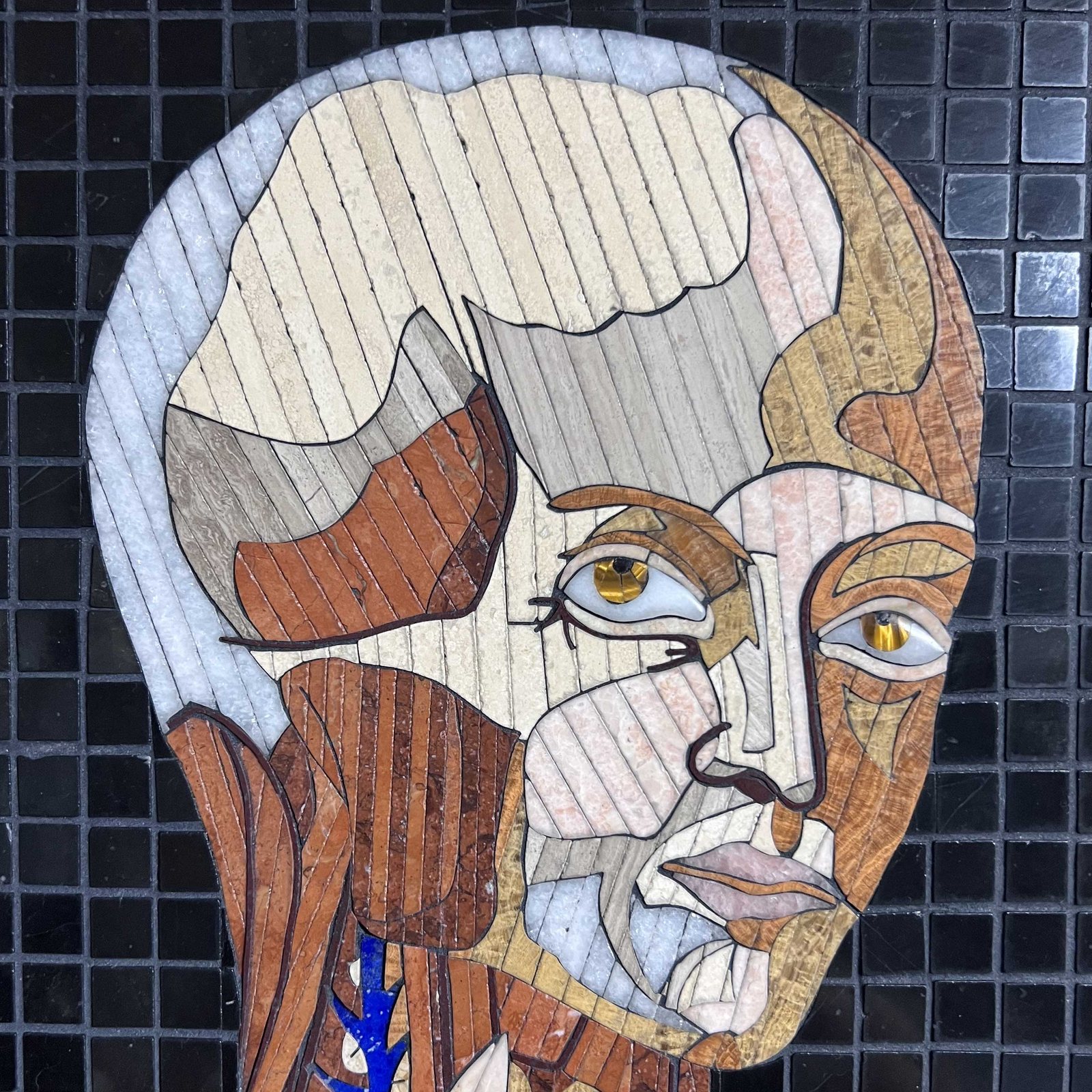
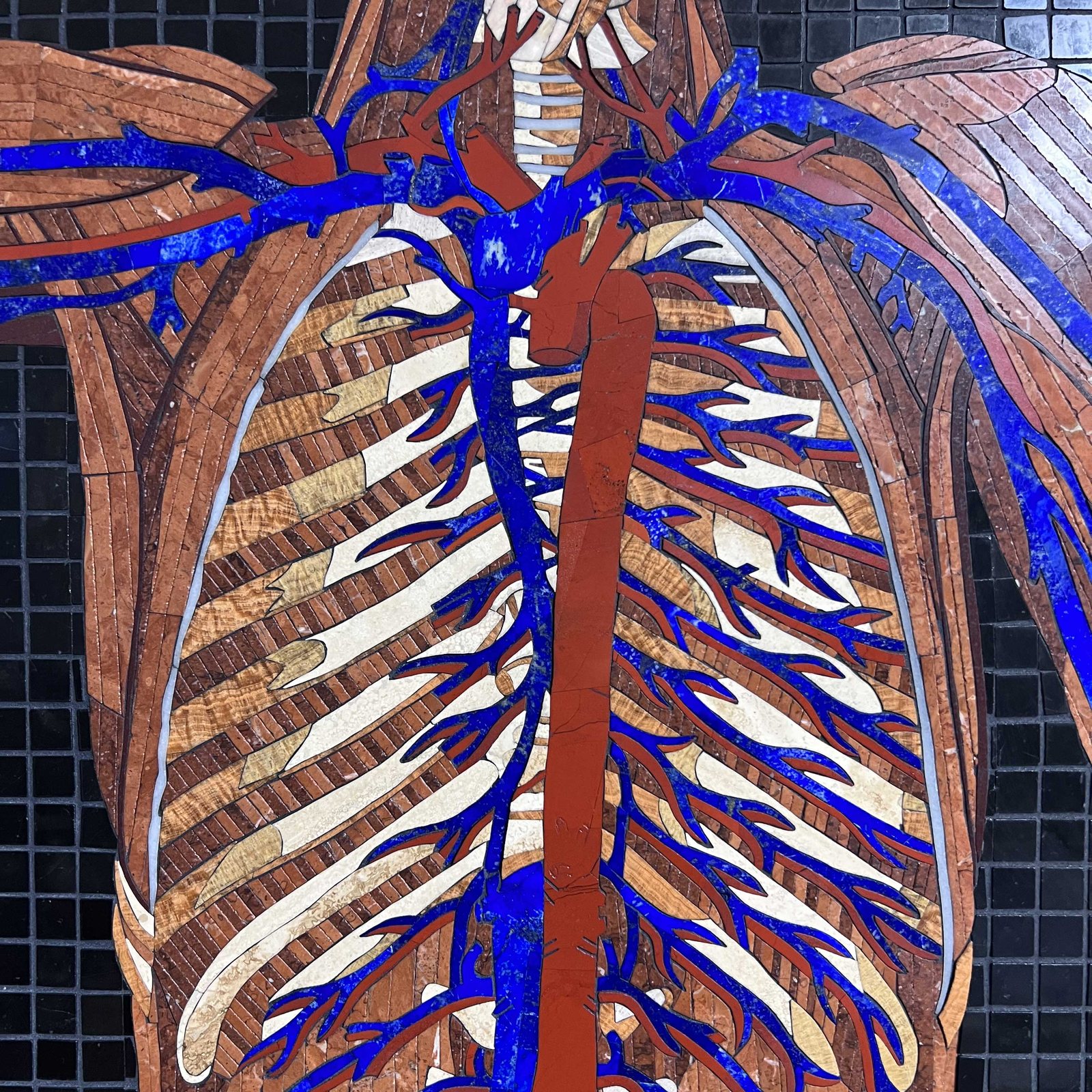
The structure within us all comes to life in Anatomy Set in Stone — life-size figures after the anatomical engravings Bartolomeo Eustachi completed in 1552. Mosaics executed with a painterly precision rarely seen since the Renaissance, composed of stone and precious gems. The founding collection of Musivum, the Museum of Mosaic Environments.
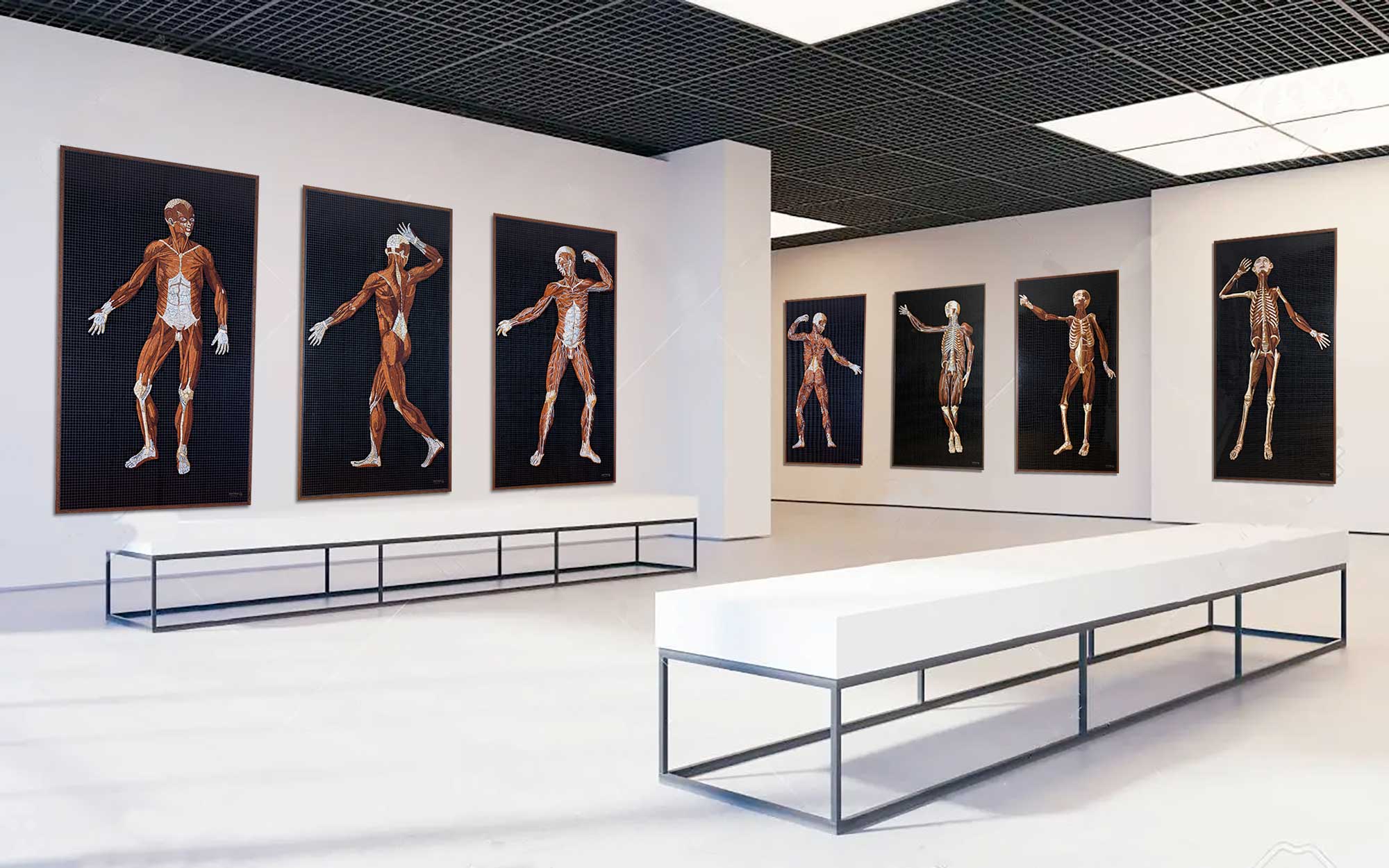
Photographs of the finished mosaics, composited into a gallery.
Twenty-two of the plates in Eustachi’s atlas show a full-length figure. The collection will hold all twenty-two, and fourteen are finished.
| Figures | 22 planned, 14 complete |
|---|---|
| Dimensions | 219 × 128 × 5 cm each (86.25 × 50.25 × 2 in.) |
| Weight | 136–159 kg each (300–350 lb) |
| Materials | Marble, travertine, onyx, limestone, blue and rose quartz, lapis lazuli, red jasper, petrified wood, star ruby, sapphire, black garnet, tiger eye |
| Substrate | Epoxy mortar and grout over Gatorfoam |
| Frames | 25 × 50 mm steel tube (1 × 2 in.), rust patina, integral French cleats |
| Source | Bartolomeo Eustachi, Tabulae anatomicae, plates completed 1552 |
| Begun | 2015 |
| Time per figure | Approximately 600 hours |
| Admission | Included in general admission |
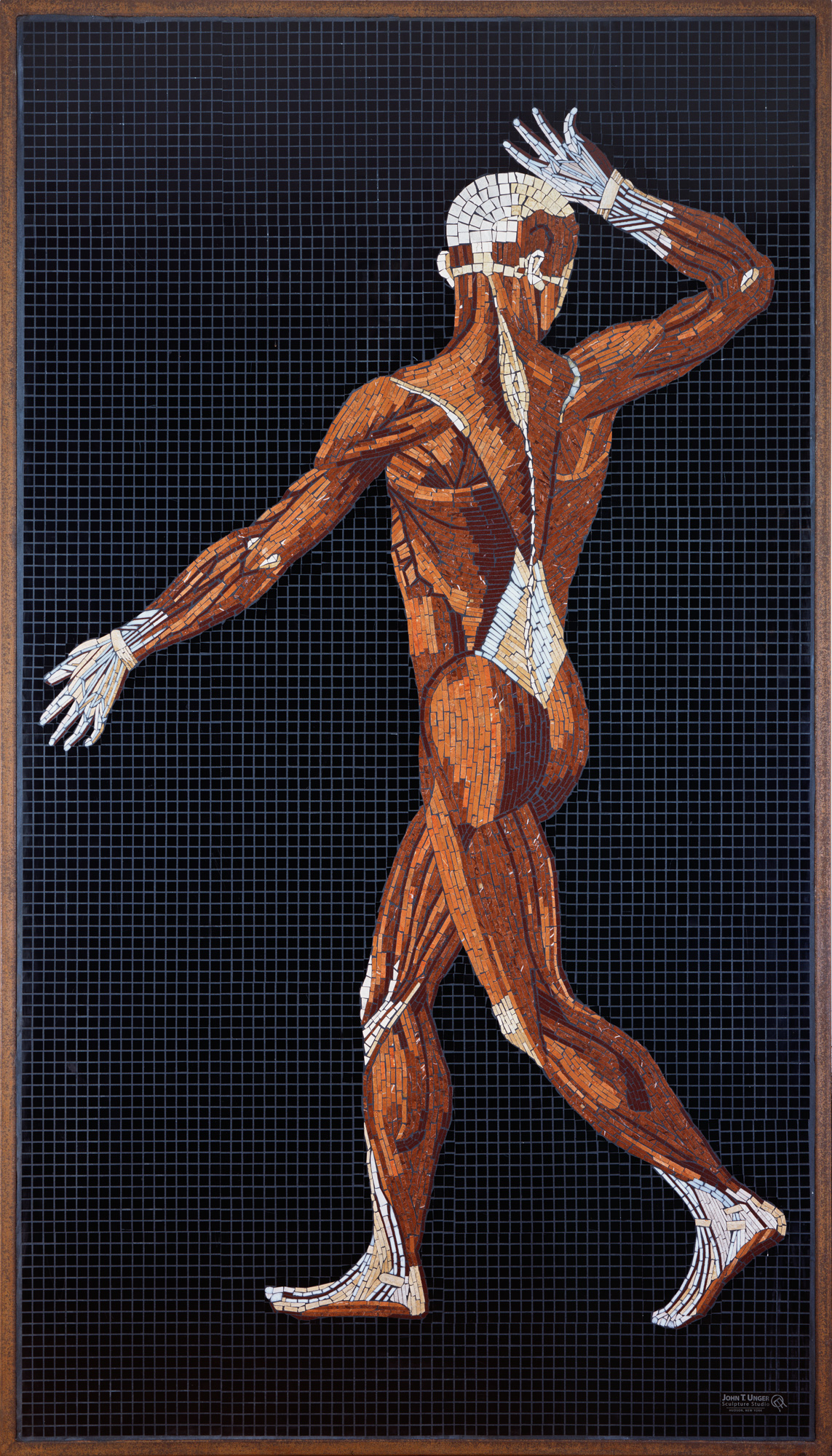
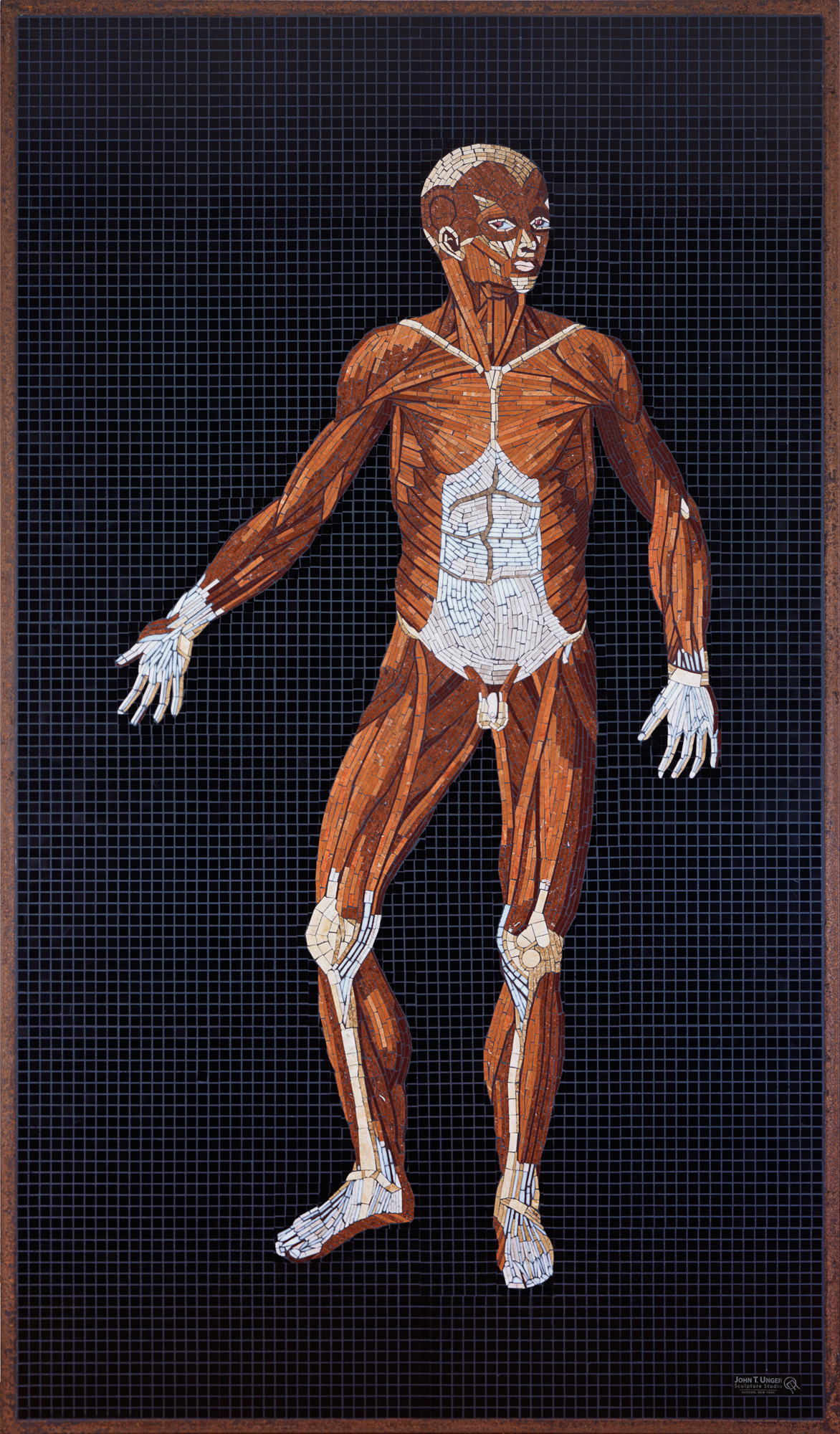
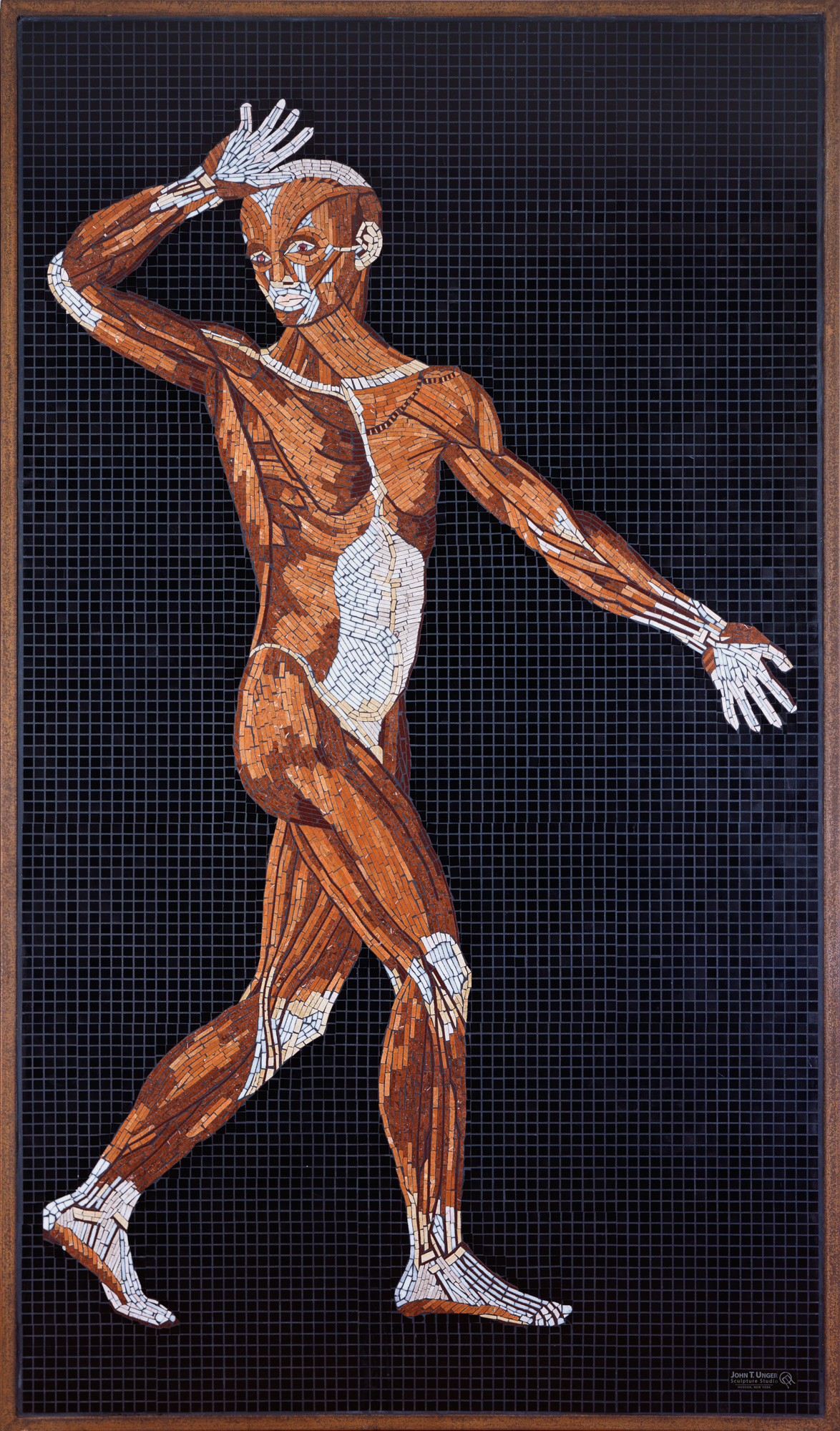

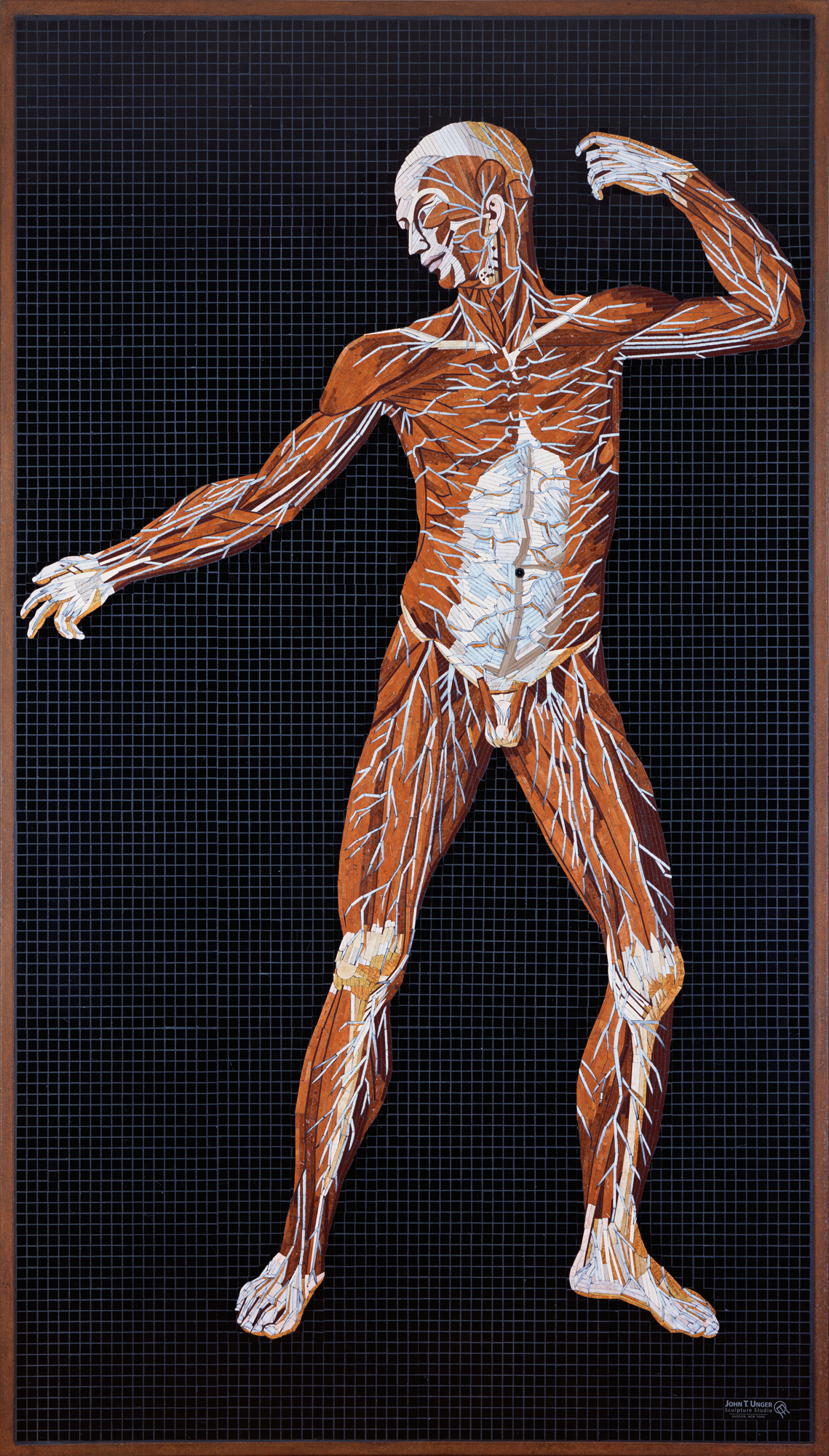
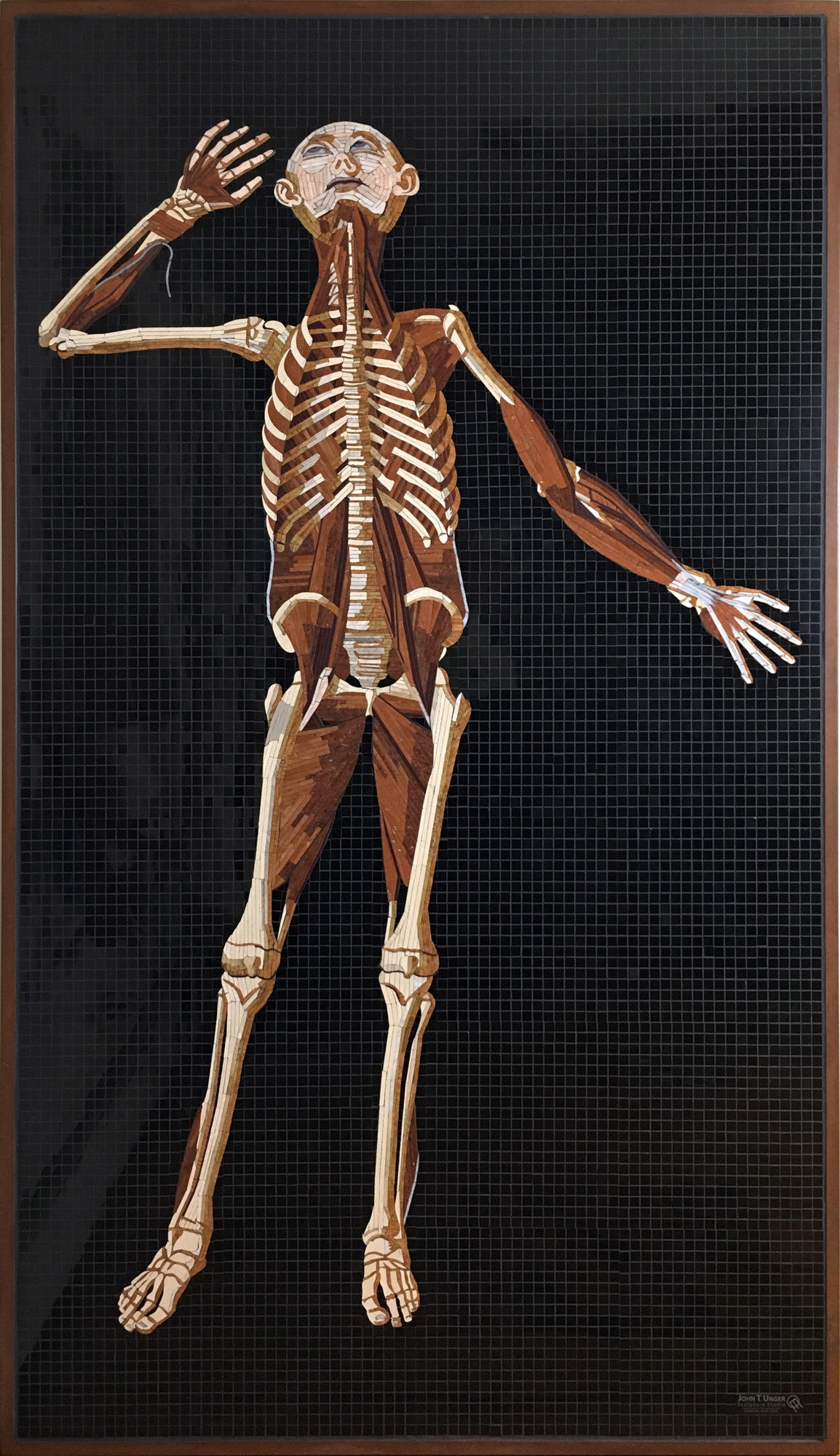

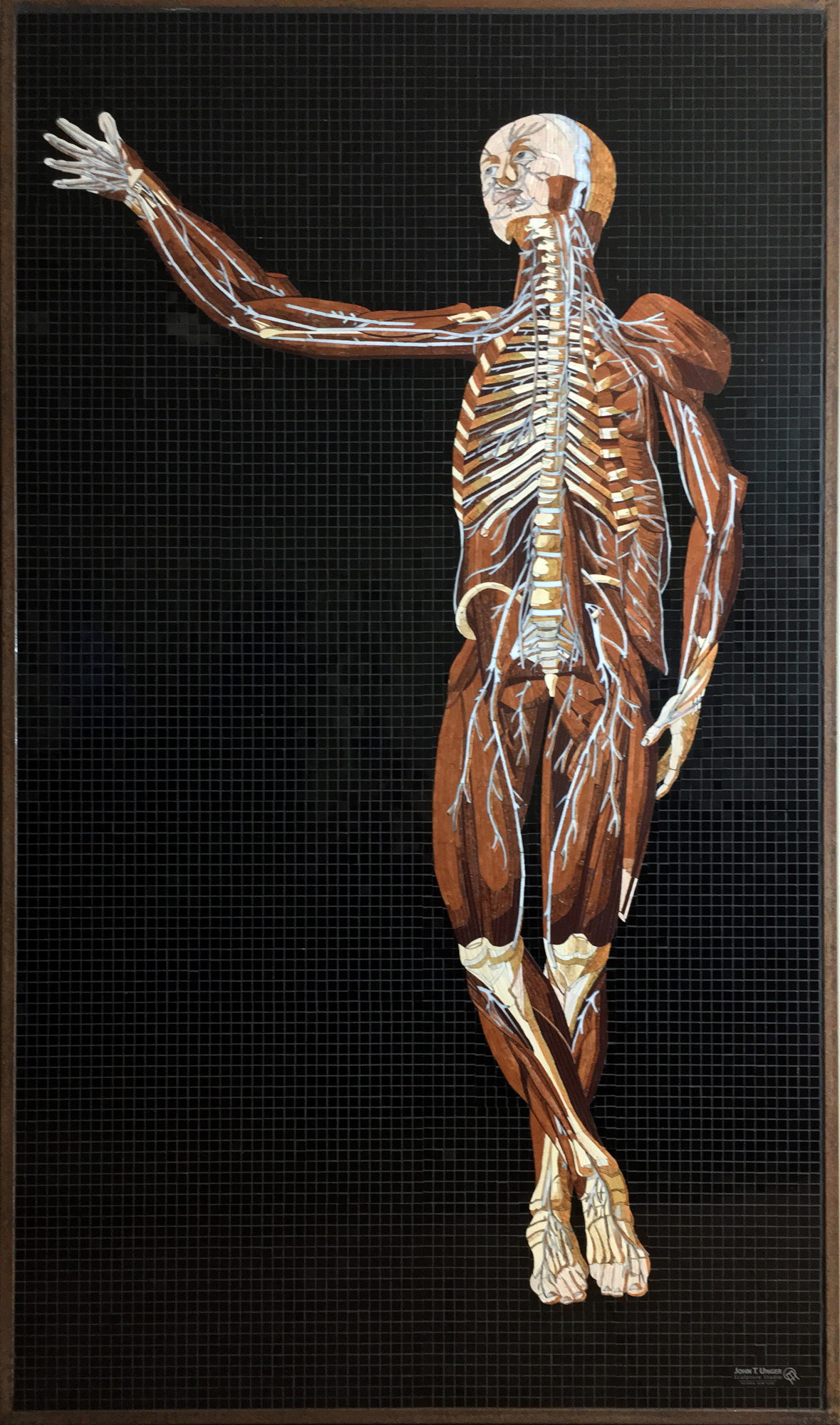
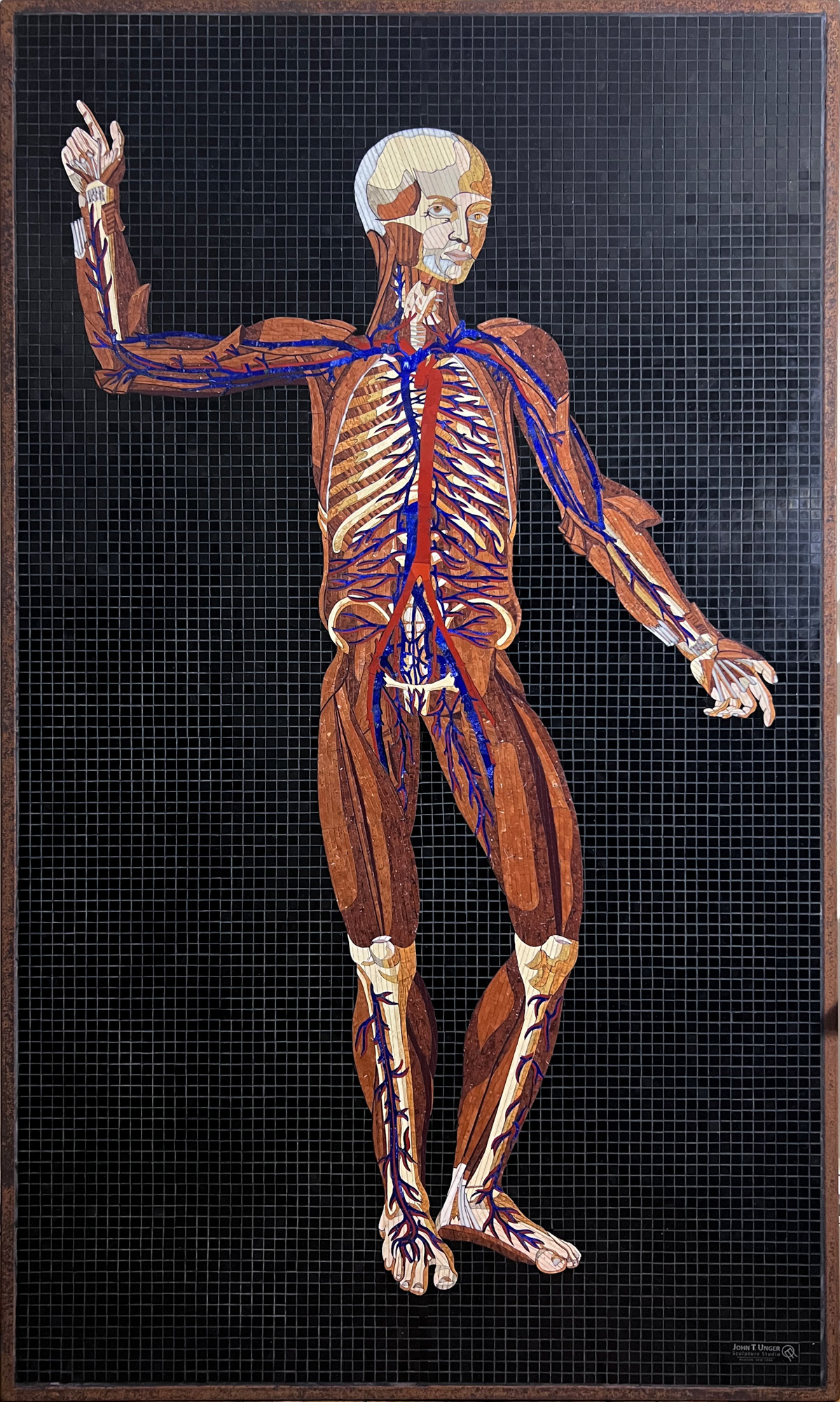

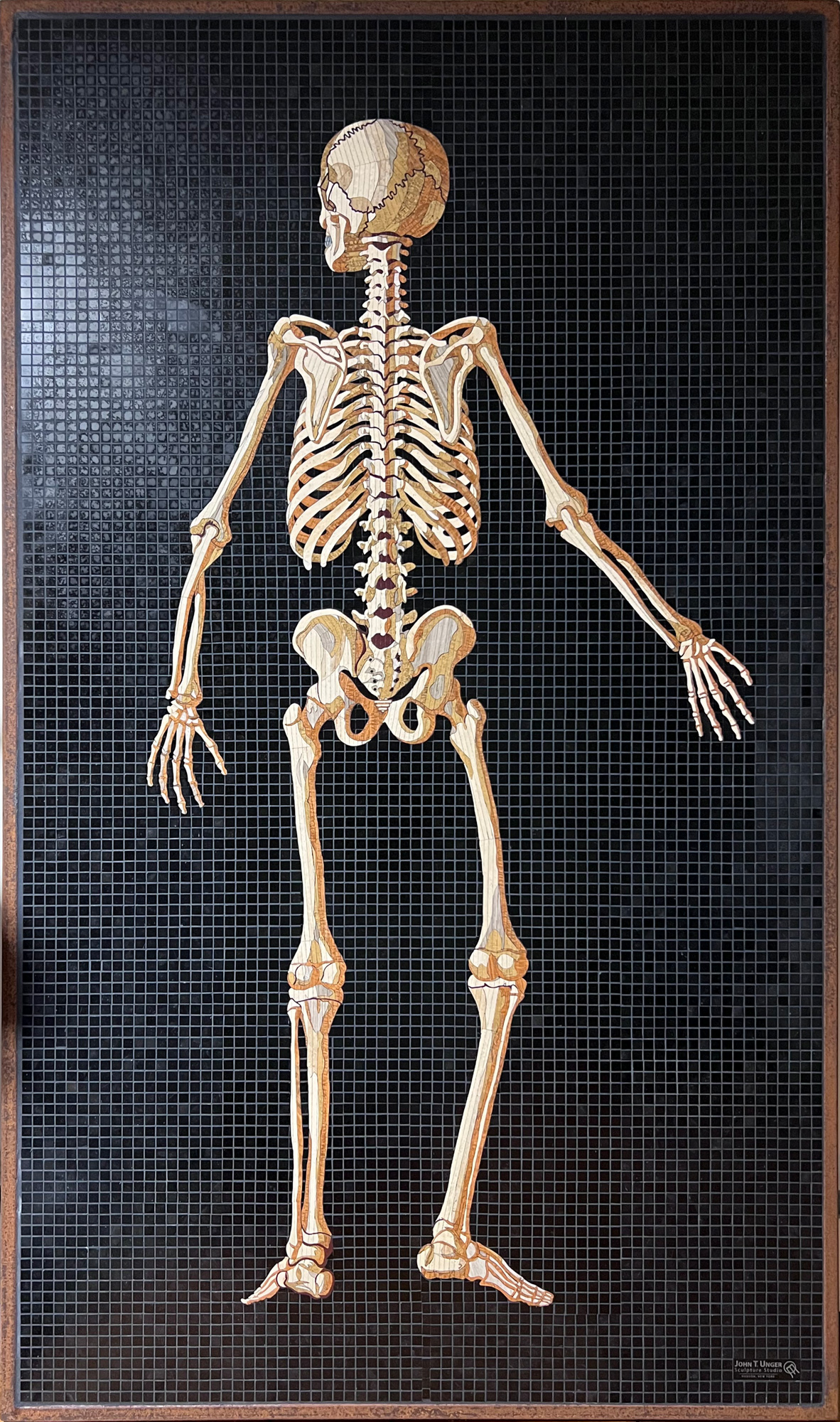
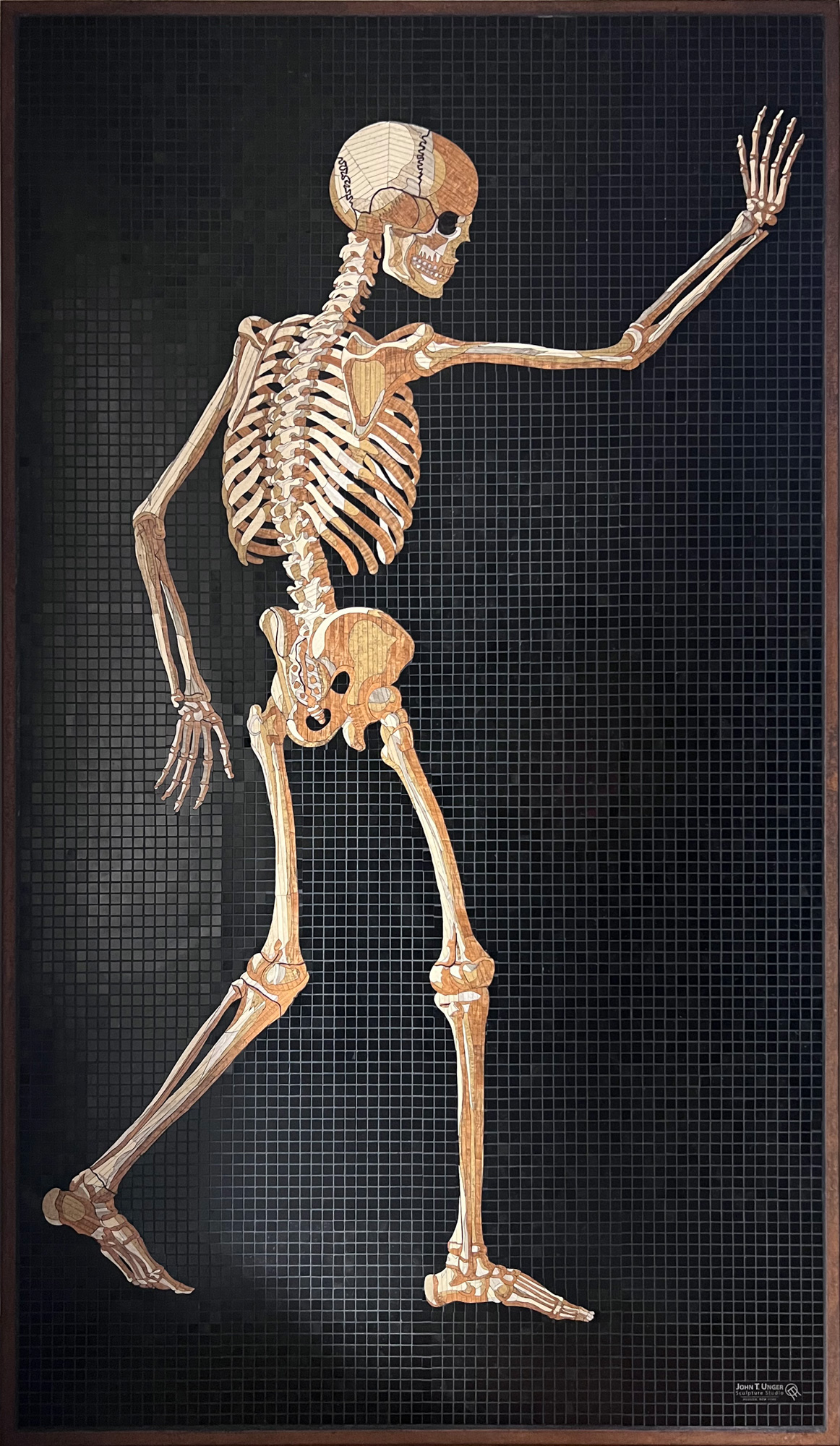

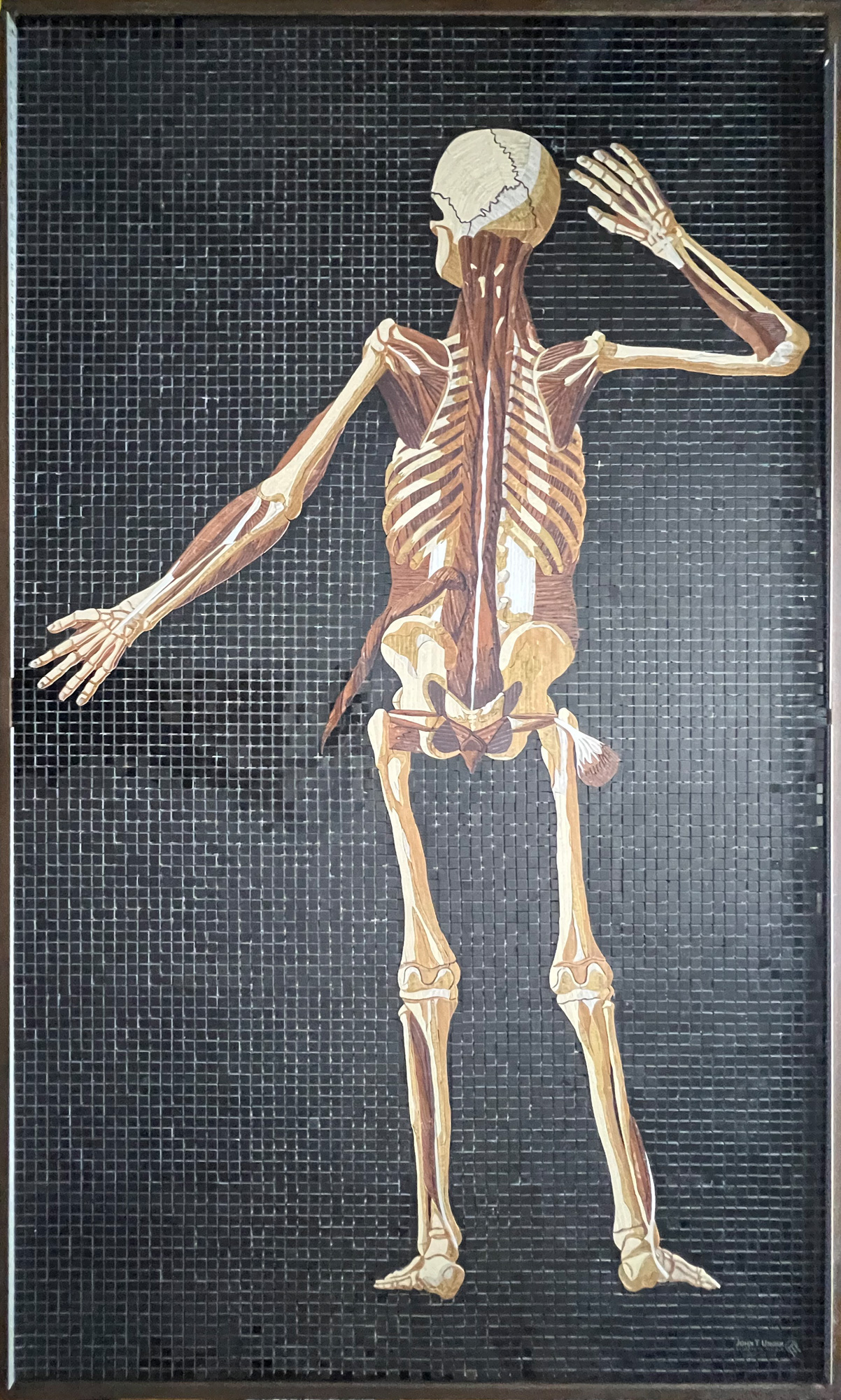
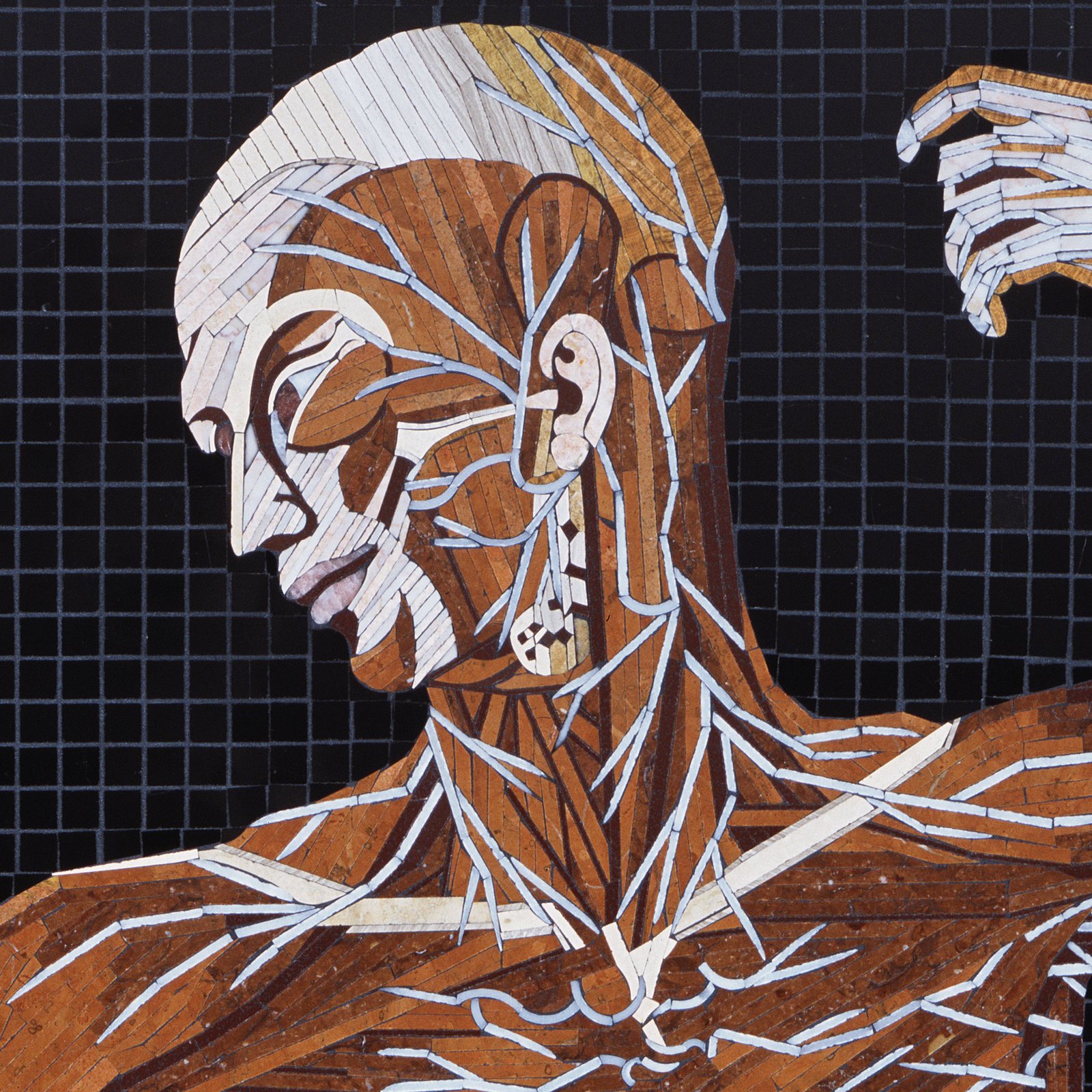
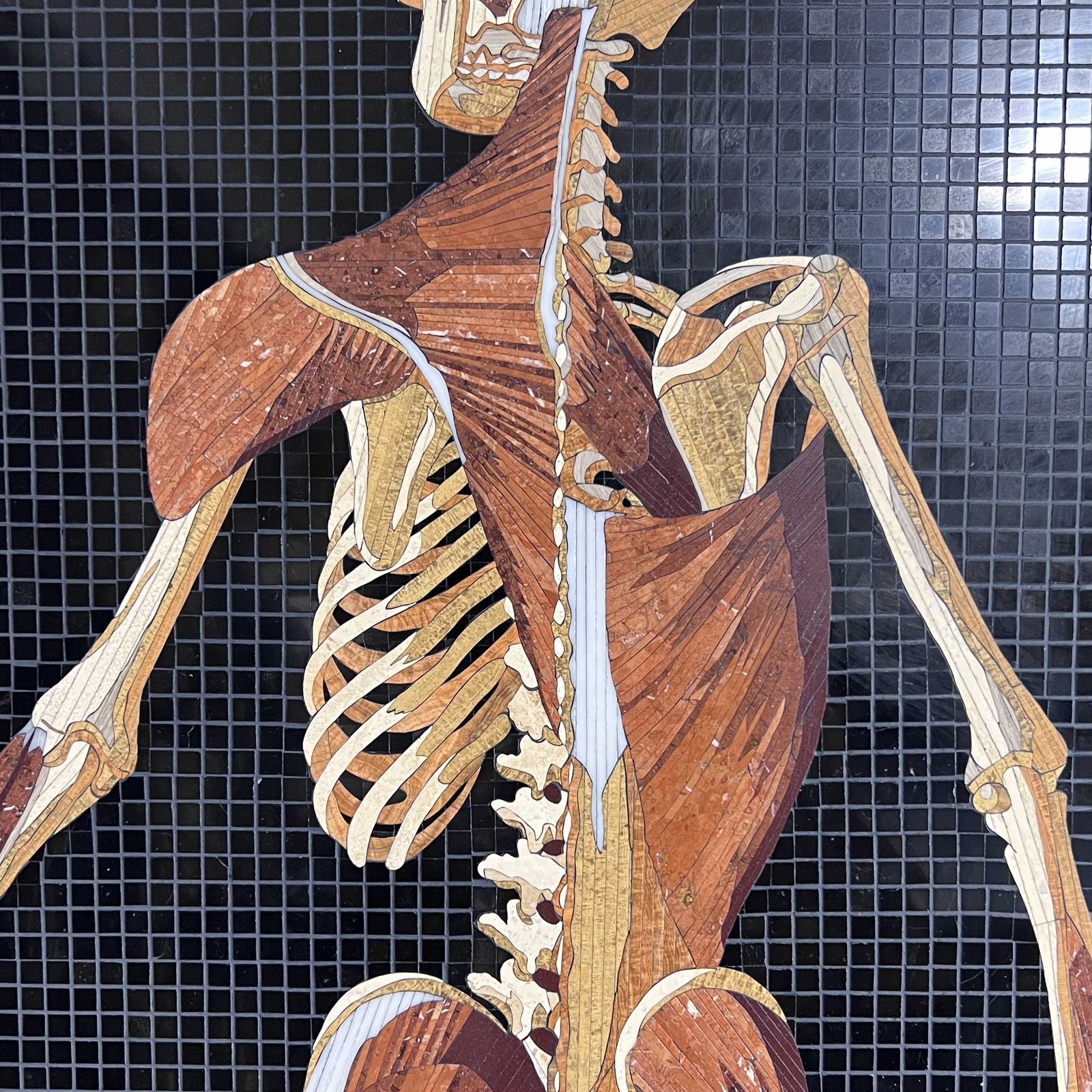

Two versions of Table 31, twelve years apart: a 2005 commission, a portion of the figure in hand-nipped marble tile, and the 2017 panel, the whole figure and the first of the series. Vargas chose the same plate so the two could be compared.
In 2005 Rachael Que Vargas made an anatomical mosaic on commission, working from Table 31 of Eustachi’s atlas. The budget covered part of the figure rather than the whole of it. Half-inch marble tiles were nipped by hand into two or three short rectangles each, and the striation of the muscle in that piece comes from andamento alone, from the direction and flow in which those pieces are laid rather than from the shape of the stone. What she wanted was longer strips, which would let the stone itself carry the striation. Nobody sold them, so she bought a saw and cut them herself.
Ten years later she started the series, and started it with Table 31 again, so that the two versions of one plate could be set against each other. The collection opens with its own control.
Bartolomeo Eustachi completed his anatomical illustrations in 1552, nine years after Vesalius published the Fabrica. Pier Matteo Pini drew them and Giulio de’ Musi engraved them, forty-seven plates in all. They were not published. Eight appeared in 1564; the remaining thirty-nine passed to Pini’s descendants and stayed out of view until the early eighteenth century, when Pope Clement XI bought them for 600 scudi and gave them to his physician Giovanni Maria Lancisi. Lancisi published the full set in 1714 as Tabulae anatomicae Bartholomaei Eustachii quas a tenebris tandem vindicatas, the anatomical illustrations of Bartolomeo Eustachi, rescued from obscurity.
Charles Donald O’Malley’s judgment on the loss is that anatomical studies would likely have reached maturity a century earlier had the plates been available.
In 2016 the United States National Library of Medicine supplied high-resolution files of its 1783 edition, through Michael North and the library’s Historical Anatomies website, at a resolution that allowed the engravings to be printed at the scale of the finished mosaics. Of the forty-seven plates, twenty-two document a whole figure, and those twenty-two are the collection.
O’Malley, Charles Donald. “Eustachi, Bartolomeo.” Complete Dictionary of Scientific Biography, Charles Scribner’s Sons, 1970–80.
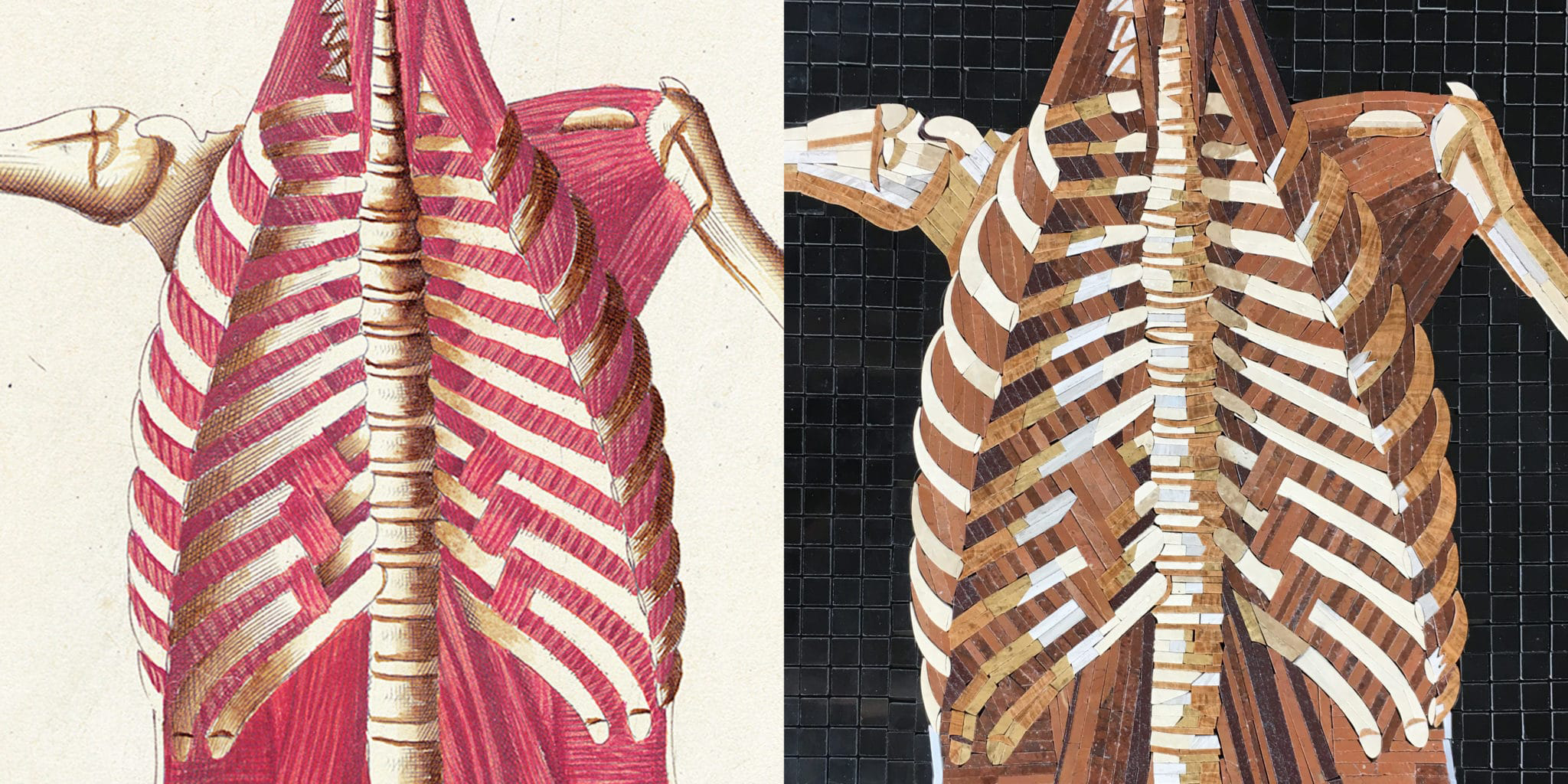
Table 38 beside its engraving at the same scale. Musivum will hang every panel this way, each plate printed on aluminum at mosaic scale.
The modernist procedure took a subject and broke it into abstract form. Anatomy Set in Stone runs that operation in reverse: the forms are the material, and Rachael Que Vargas assembles the figure out of them.
Biomorphic abstraction, form derived from organic nature, ordinarily stays abstract. Here it resolves into a body. Organic abstraction used as the construction material for representation is the formal position of this collection, and every panel is built that way. A rib, a hand, a jaw arrives by putting form together rather than by taking a body apart.
The forms themselves are old, and they are consistent. Vargas derives them from meanders and oxbow bends, from anemones and paramecia, from rock cut by wind and water. Decades of field study, studio experiment, and relentless examination of how materials and objects relate to their environment produced a grammar as well as a vocabulary, and the difference decides what the work can do. A borrowed vocabulary permits quotation. A grammar permits statements the source never made.
So one system yields cut steel, fabricated fencing, aluminum jewelry, furniture, and the panels in this collection, across disciplines, materials, and subjects that have nothing else in common. In 2019 the writer and artist Austin Kleon, who arrived a skeptic, spent an afternoon in the studio and recognized the hand unprompted, matching the ear in a panel on the work table to the offcuts from a steel firebowl. A reproduction offers nothing for a stranger to recognize.
The commitment underneath the position came from reading ecosystems, and Vargas states it as a fact about the world rather than a preference about composition: nothing in an ecosystem is background. There is no empty space, only other systems in contact. Mosaic is where that stops being a preference and becomes a physical condition, because every tessera is bounded by its neighbors and each form is cut out by the forms around it. Figure and ground are made in one operation. Musivum holds this collection because the panels argue that proposition in the medium the museum is built on.
The essay below sets out the evidence.
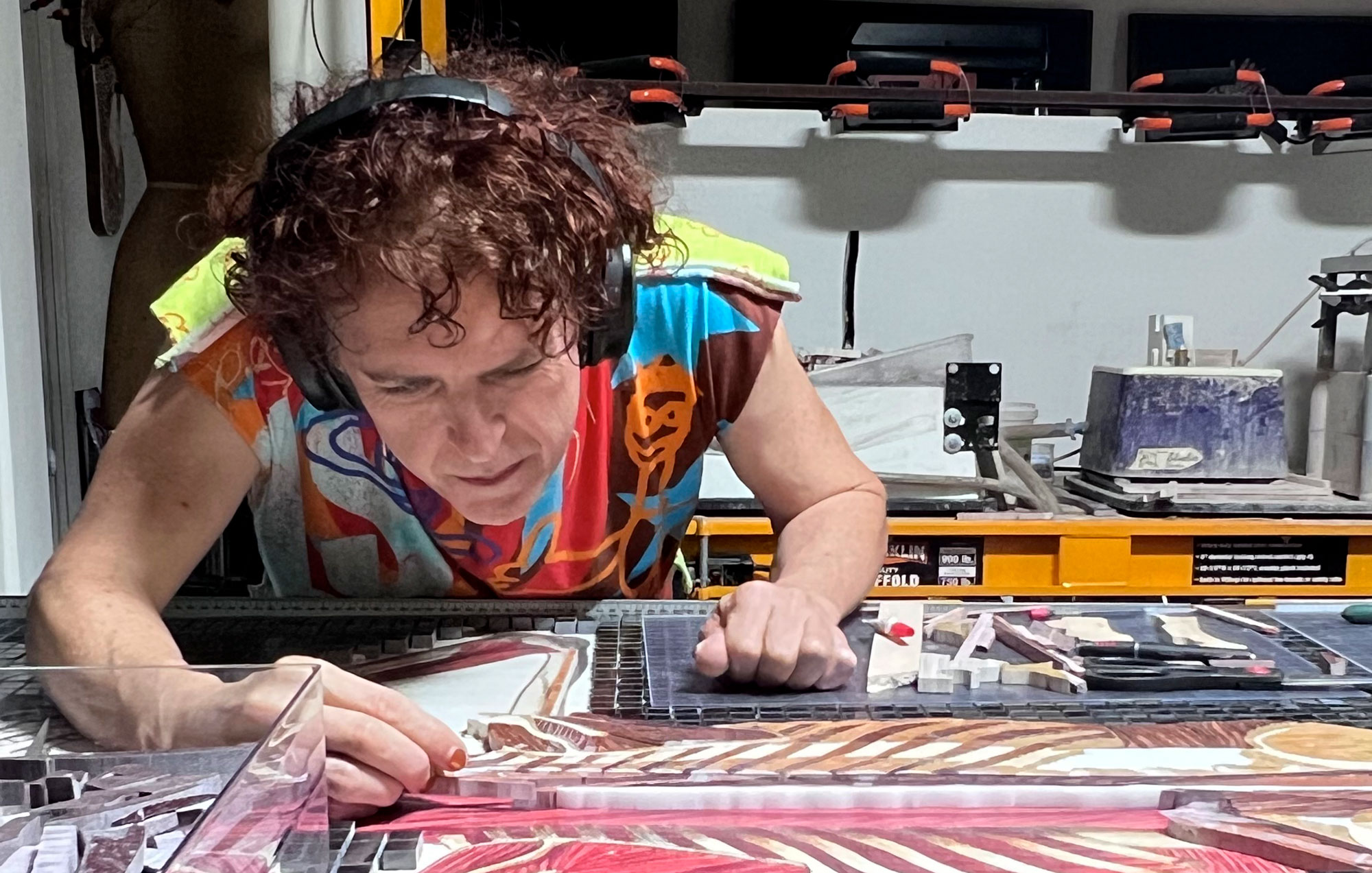
Rachael Que Vargas setting tesserae for Anatomy Set in Stone
Each mosaic begins with 12-inch stone floor tiles cut on a wet saw into strips as thin as a single millimeter. Both the stone supplier and the saw manufacturer said that tolerance was impossible. Reaching it took a customized cutting tray with a 2-inch lexan backstop to damp vibration, template strips to hold consistent widths on the long cuts, and a decade of refinement.
The crosshatching in Eustachi’s shading is matched by cutting striated limestone at four angles, with the grain, across it, and on both diagonals to produce a chevron. Two shades of banded onyx, yellow and orange, were added later to bring the color closer still. The circulatory system is lapis lazuli and red jasper. The eyes are beveled star ruby, sapphire, black garnet, and tiger eye, set to stand slightly above the surface.
Stone was bought in bulk at the outset, because natural stone varies between quarry runs and a color matched a year later will not match. Nothing is dyed. Vargas tested staining striated limestone with rust and water, a process the ground performs on its own, and rejected it: stone that has been colored cannot demonstrate that stone already carries the colors of the body, and demonstrating that is the point of the collection.
The tools grew with the difficulty. Tile nippers and a wet saw carried the early muscle figures. The nervous and circulatory plates required a flat lap wheel, a spindle grinder, and finally a diamond band saw, which now shapes nearly every piece. The change is visible in the objects: on Table 38 the lower hand is cut the earlier way and the upper hand is cut on the band saw, a few feet apart on one figure.
Installation runs inverted, because both standard methods are unavailable. A large mosaic is normally taped, cut into sections, and lowered face up into wet mortar. These panels are interleaved too finely to cut and too heavy to lower. So the mortar comes to the mosaic: the face is taped in 12-inch vinyl, the panel is turned, and every stone is tamped level from the back with a wooden chopstick, thousands of them, because stone from different sources varies in thickness by a fraction of a millimeter and the variation shows. Fine sand fills the gaps, the mortared substrate is lowered onto the back, and the panel cures face down and flat before it is turned again and grouted. Vargas built a table that rotates on its long axis to perform the turn, after doing the first two by hand.
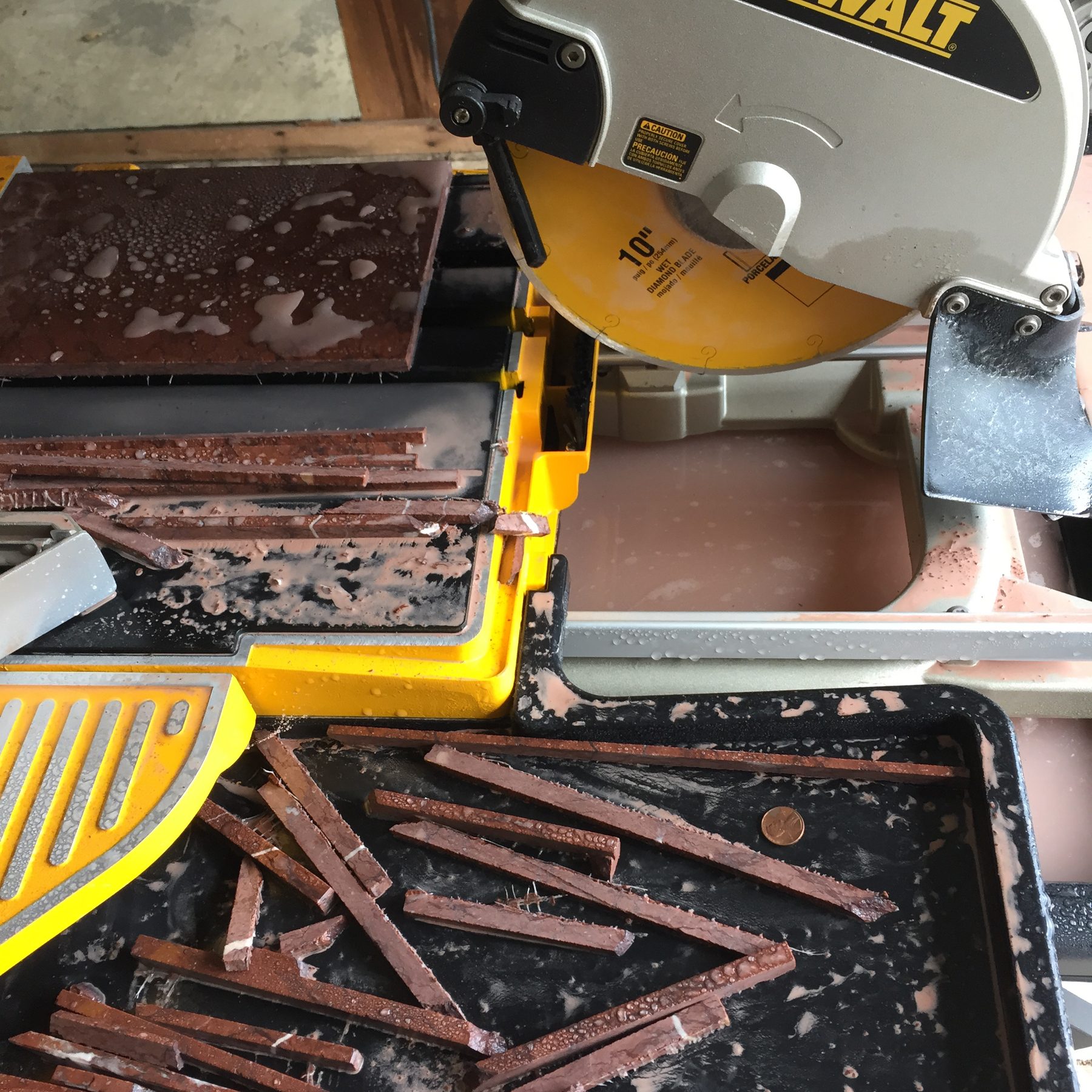
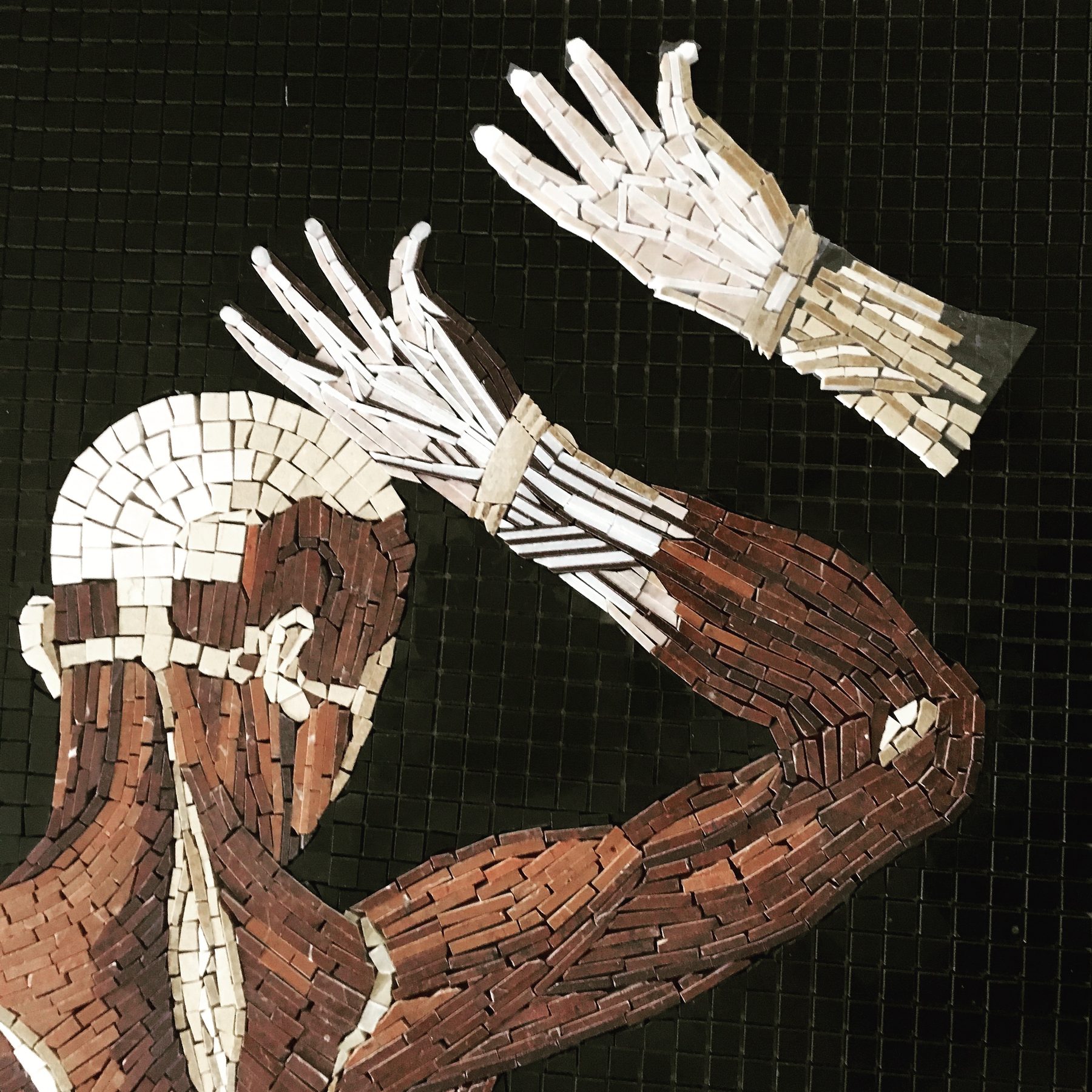
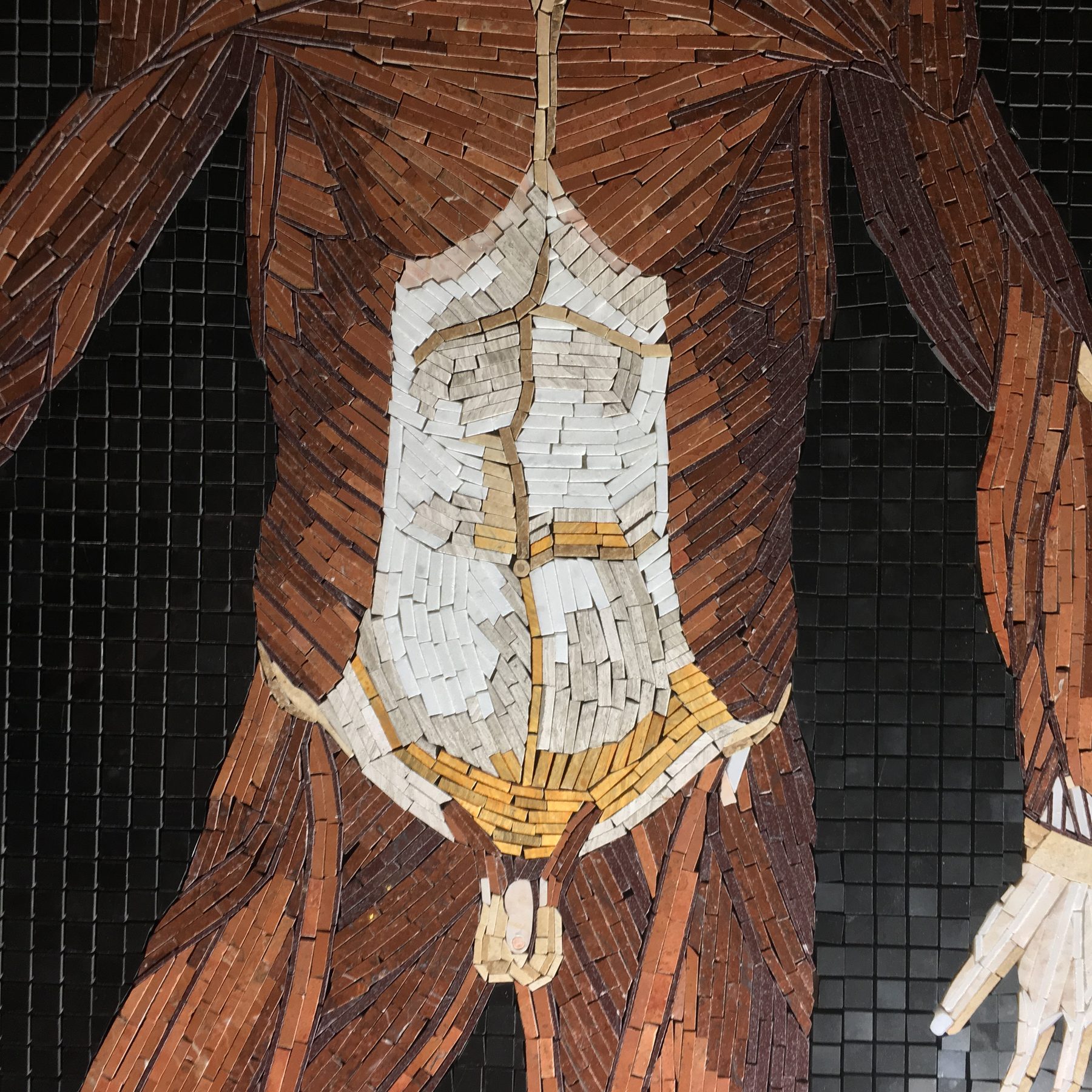
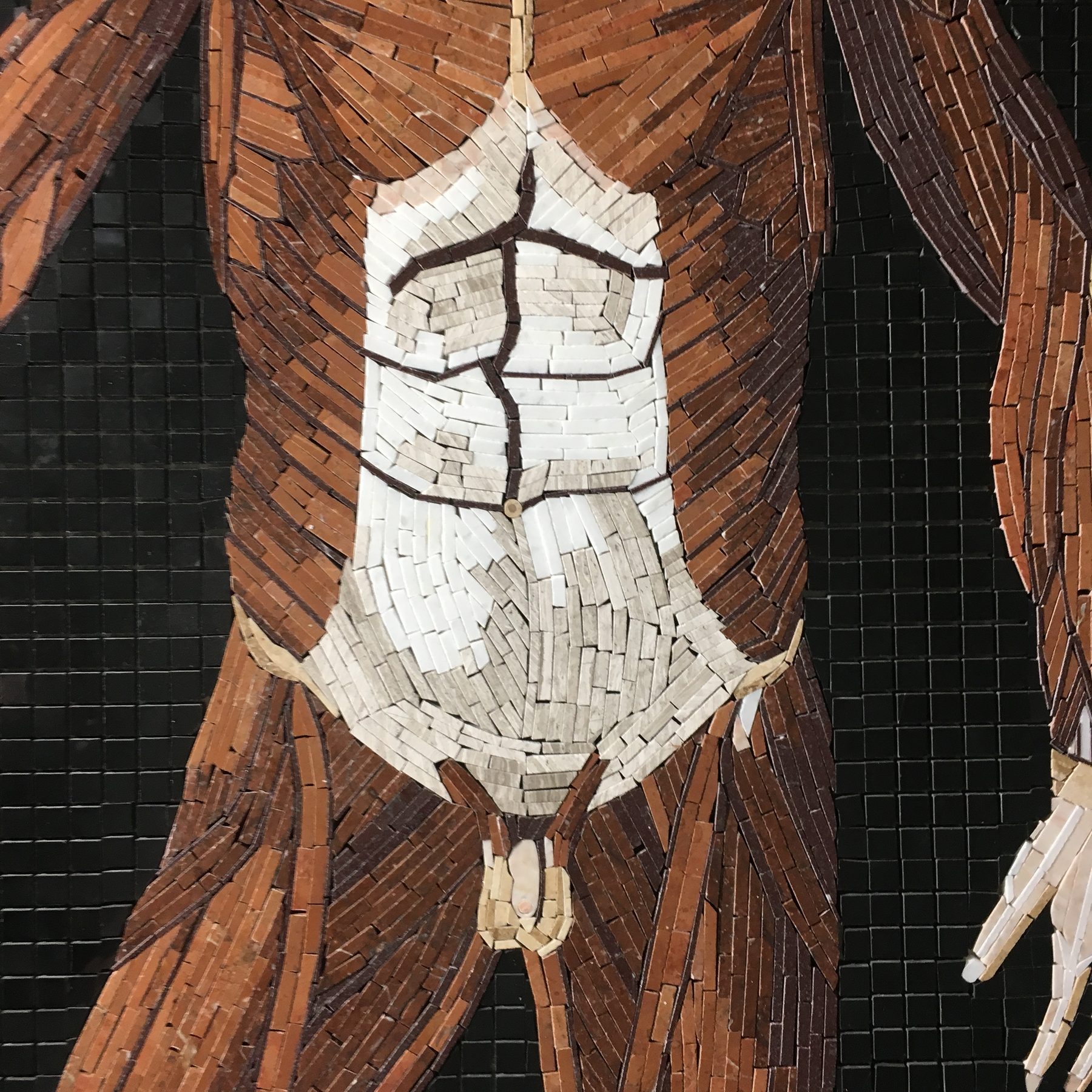
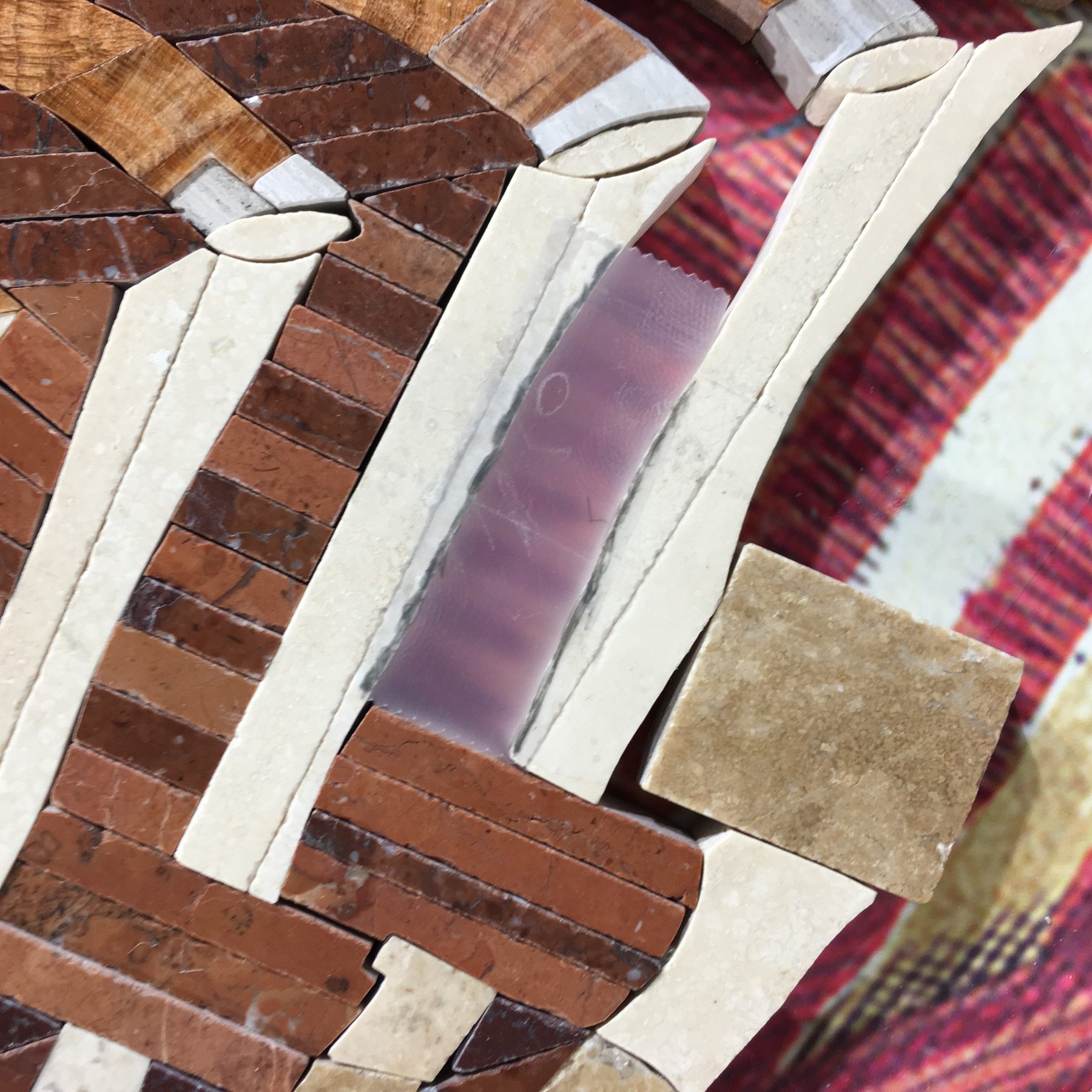
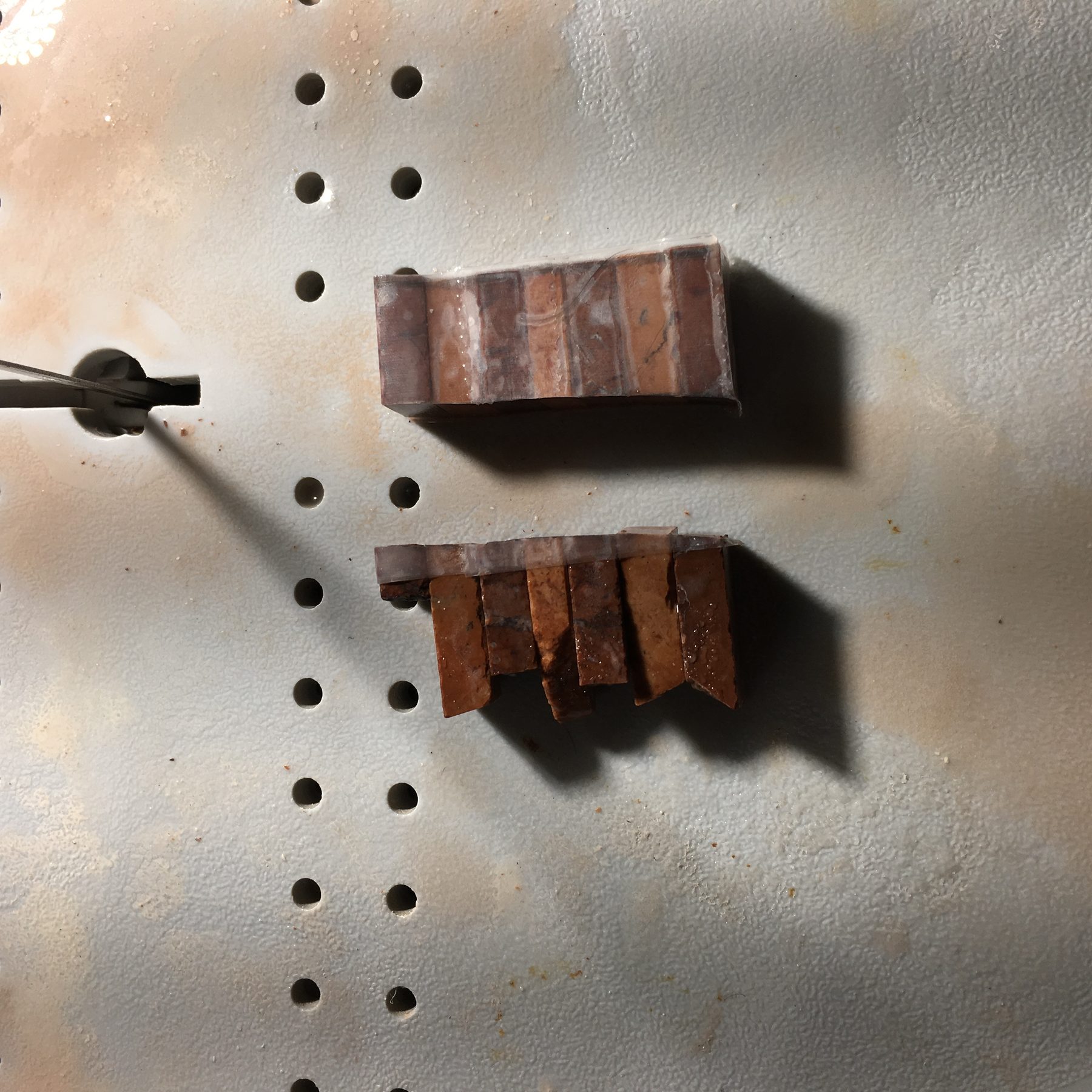
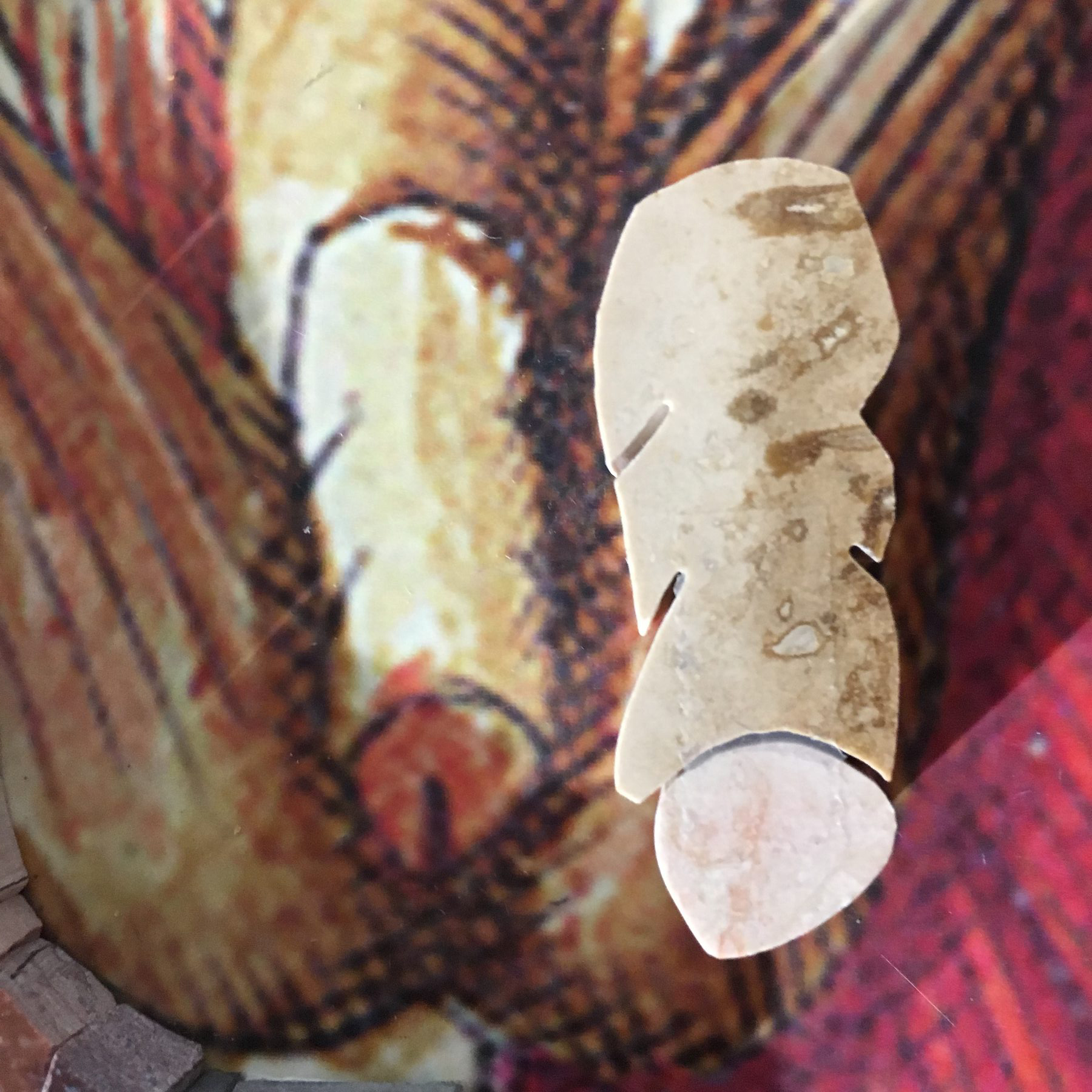
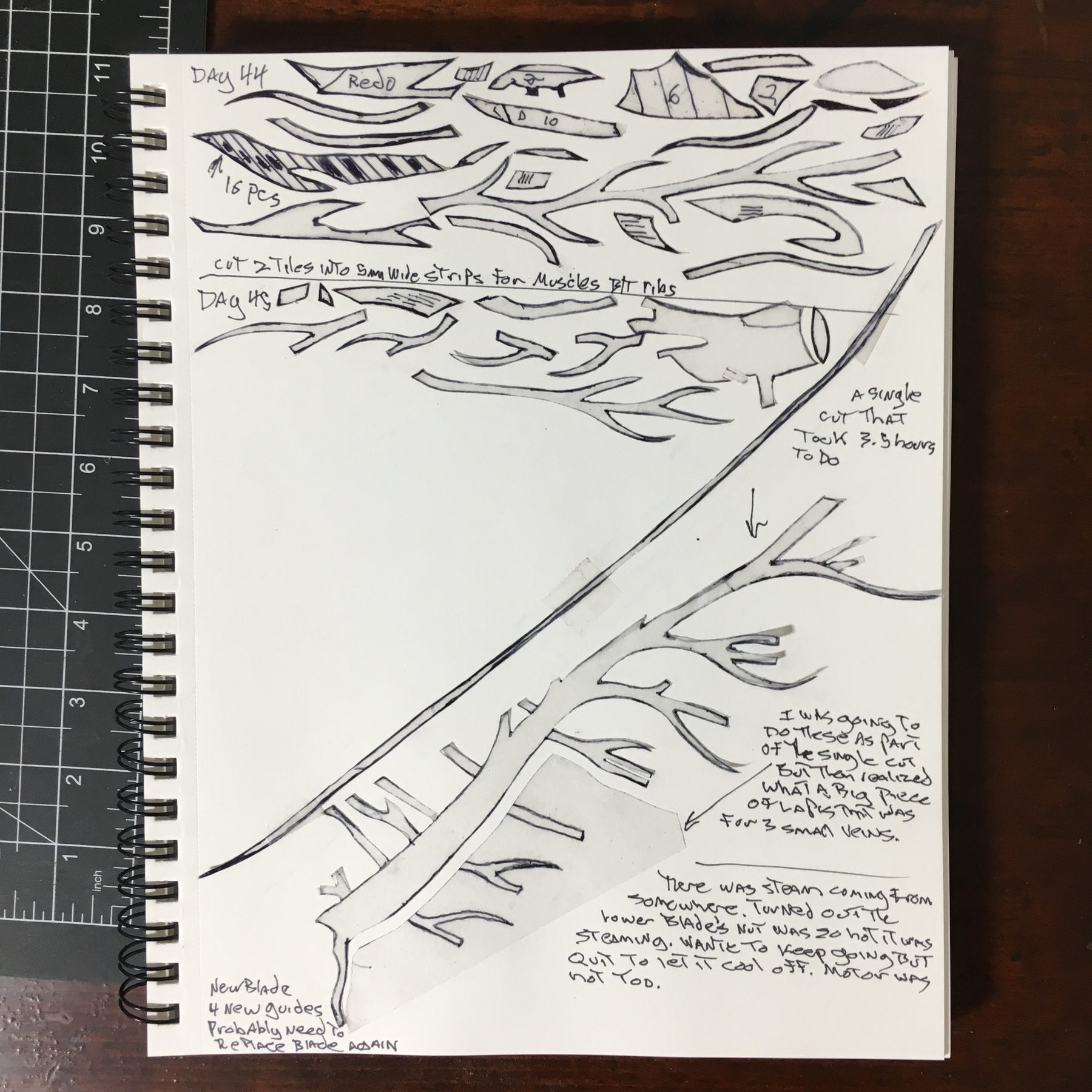
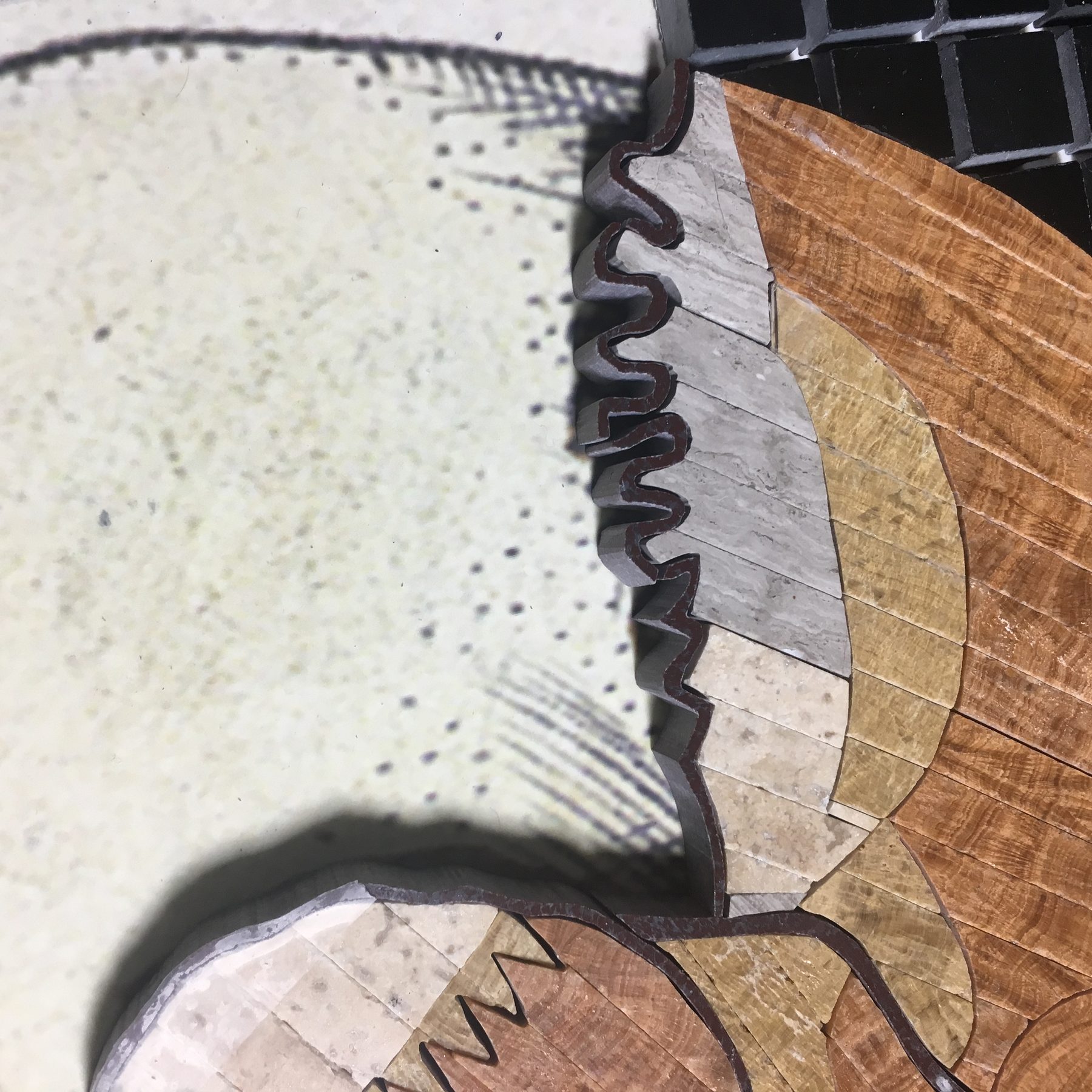
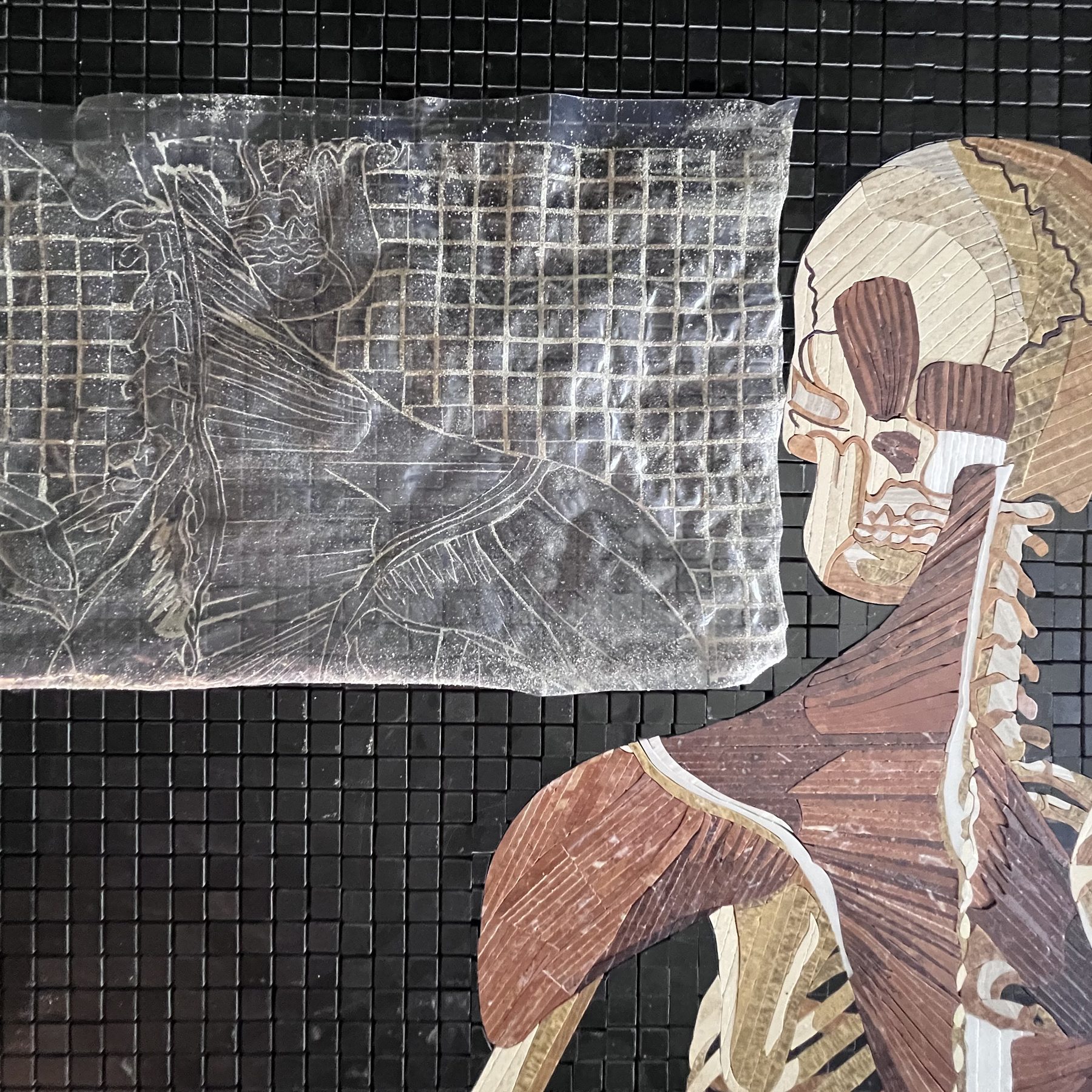
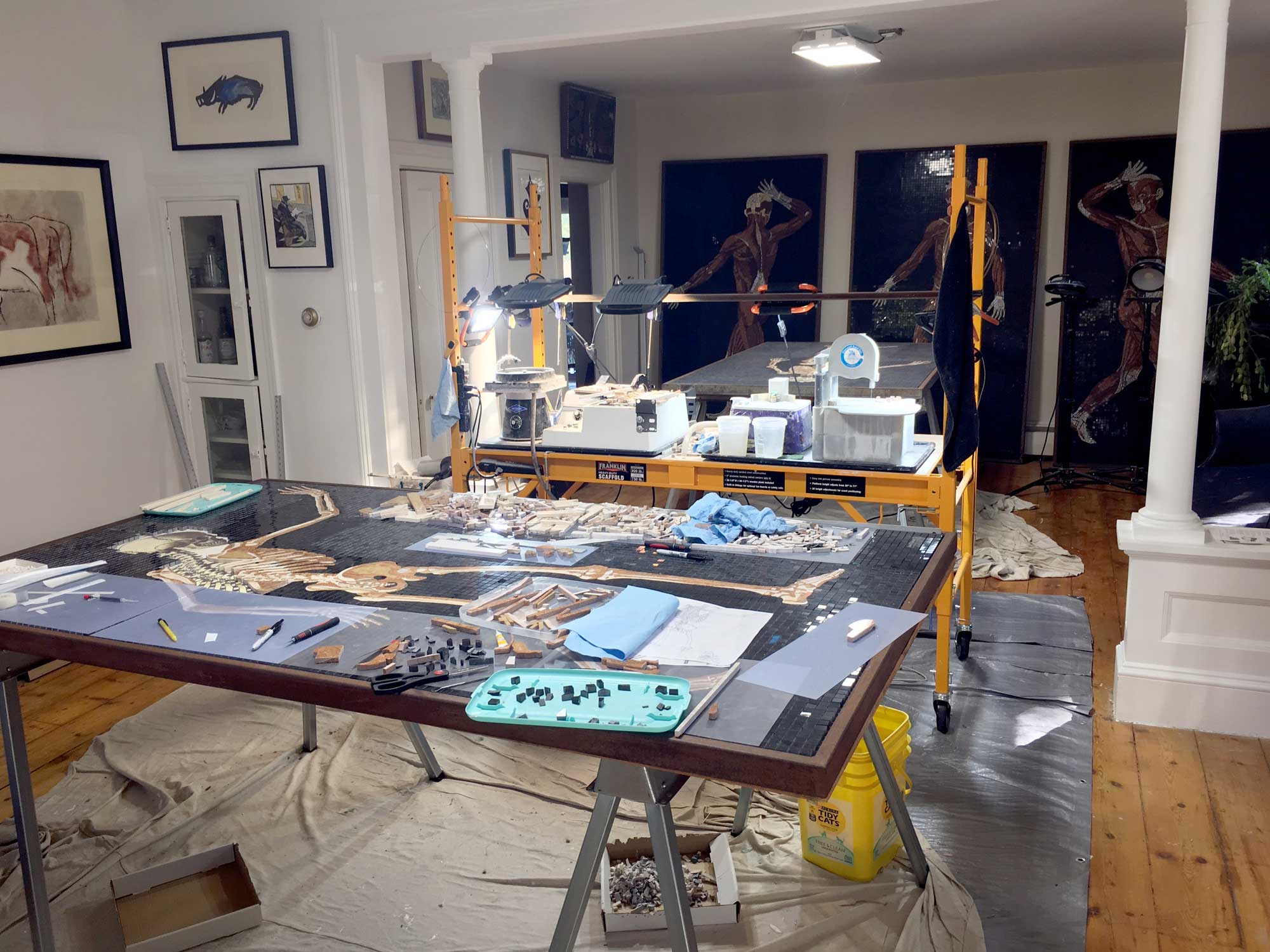
Anatomy Set in Stone — mosaic in progress
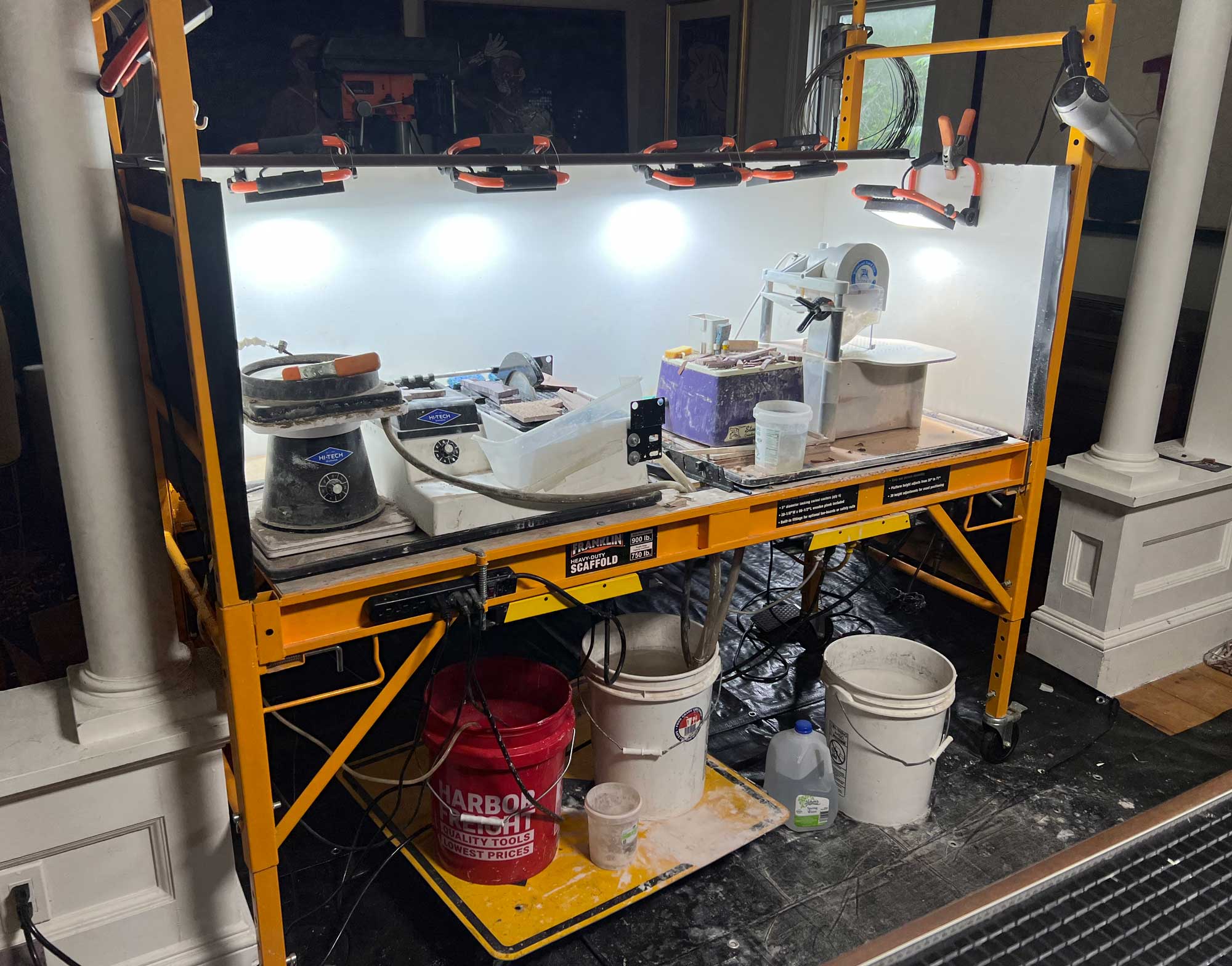
Lapidary workstation with diamond wet saws and grinding machines used for Anatomy Set in Stone

[Bartolomeo Eustachi] has been historically overshadowed by many of his scientific counterparts in the Renaissance. The work of Rachael Que Vargas… could change that.
Blakemore, Erin. “Artist’s Stone Mosaics Are Life-Size Homages to Renaissance Anatomist.” Washington Post, 22 Aug. 2022.

Eustachi’s illustrations are expressive, [Vargas’s] renderings in stone are impressively dynamic.
Circulating Now. “Anatomy Set in Stone.” National Library of Medicine, 11 Aug. 2022.

Life-size and hyper-detailed, these anatomical mosaics draw on ancient inspiration.
Donahue, Michelle Z. “This Artist Redefines a ‘Chiseled Body’.” Smithsonian Magazine, 1 Oct. 2018.

An artist is making massive monuments to medical illustration.
Hester, Jessica Leigh. “Turning Anatomical Drawings Into Mosaics, Stone by Stone.” Atlas Obscura, 8 Jan. 2019.

I must admit, I thought it sounded like a quixotic task. These things simply must be seen to [be] believed.
Kleon, Austin. “A Visit to John T. Unger’s Studio.” austinkleon.com, 16 May 2019.
| Year | Venue | Works shown |
|---|---|---|
| 2019 | Carrie Haddad Gallery, Hudson, New York | Two panels, in Mortals, Saints & Myths, 12 June – 28 July |
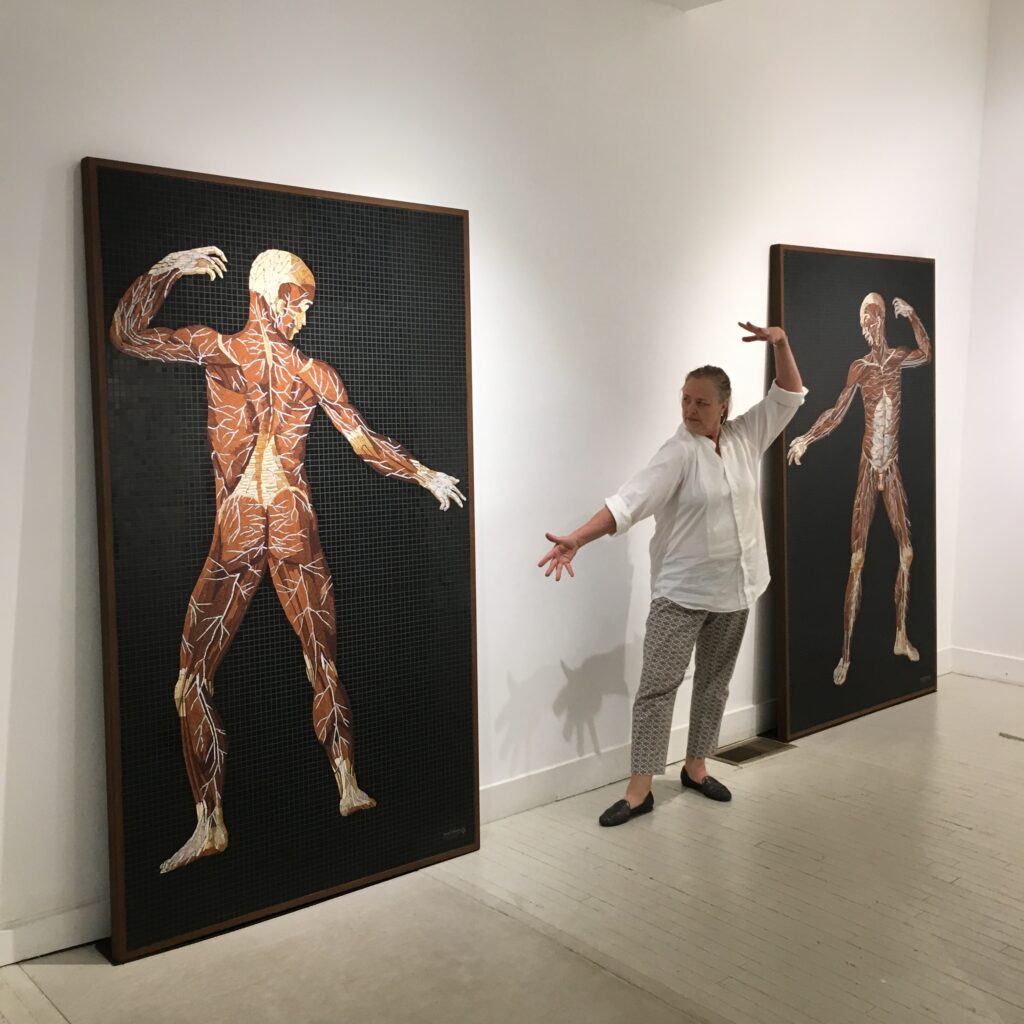
Gallerist Carrie Haddad poses to mirror the figure in a marble mosaic from Anatomy Set in Stone, in Mortals, Saints & Myths, Carrie Haddad Gallery, Hudson, New York, 2019
ESSAY
Engravings of cadavers from 1552 come startlingly to life through thousands of hours of cutting and arranging stone. Reading ecological systems supplied the grammar and vocabulary of natural forms behind the work.
Anatomy Set in Stone is three kinds of picture at once, and it is each of them literally rather than by analogy.
It is still life. The French name for that genre is nature morte, dead nature, and Bartolomeo Eustachi worked from cadavers.
It is portrait. Figures at life size, scaled so that a viewer meets them at the height of an encounter and finds themselves mirrored.
It is landscape. A terrain of interrelated systems, rendered in the material of terrain.
Only the first of those is inherited. The plates supply the corpse. The scale that makes these portraits and the stone that makes them landscape are both decisions, and the collection exists because of the second one.
In 2005 Rachael Que Vargas noticed that stone comes out of the ground in the colors of the interior of the human body. Marble is muscle. Travertine and striated limestone are bone. Lapis lazuli is a vein, red jasper an artery, petrified wood the concentric grain of an eye socket. The observation is a claim about the world rather than about art, and testing it took a decade.
It had already produced one work. Immediately before the first anatomical mosaic, Vargas made Erastes and Eromenos, after an erotic scene on a Greek red-figure vase, because she had marble in the exact shade and tone of the fired clay. A painted pot and a stone floor tile share almost nothing: different art forms, twenty-four centuries apart, one of them a subject and the other a raw material. They share a color. That was enough. The piece it produced is not a landscape and not a still life, and it used no technique she had not used before.
What the two works have in common is the move that made them, which is looking hard at the least obvious way two unrelated things overlap. The Greek mosaic gave her the anatomical one, and the anatomical one raised the question the series exists to answer, which is how far the same move can be taken.
Eustachi’s plates are the instrument of that test, not its subject. Vargas chose them for practical reasons: they were in the public domain, they were available at high resolution, and they were in color, which mattered because a monochrome atlas would have left her guessing at which tissue was which.
Where a target image already exists, every decision has a correct answer determined by that target. The work is to approximate it. Success is measured as fidelity, and an activity measured by fidelity to an external standard is problem-solving rather than art, however difficult it is and however long it takes. On that reading these are reproductions of a book, and the only remaining question is how well they were done.
The answer is not a single rebuttal. It is what happens when one body of work satisfies three genres at the same time, each of which asks something different of it, and none of which the source supplies.
Vargas reads terrain the way a physician reads a chart, and she has been doing it for fifty years.
“What makes all of this possible for me is intense observation. Not just of the drawing, not just of the stone, but all day, every day, everywhere I go, everything I see. I look really intensely at everything I encounter, and I assess not just appearance but purpose, potential, interrelation with elements near and far, how it fits in the ecosystem, how it fits to the body, what it does, what it is supposed to do, what it could do or be, what it can’t be, how to make it be what it can’t be, what else it could be. And so on. All the time.”
She looks, in her own summary of it, “relentlessly, forensically, empirically, but with a vision for potential, reuse, transformation, and for that matter spiritual weight.”
That habit is what made the founding observation available. Someone who reads a landscape as a set of interacting systems will read a body as one too, and will notice that the two are made of the same palette. The body of the earth carries the body of the human, and it carries it in the correct colors.
Choosing a material for what it already is, rather than for what it can be made to represent, is the oldest working principle Vargas has, and she has named its source for thirty years. It comes from Bakongo minkisi, in which the active ingredient of a power object is selected because its appearance suggests the effect wanted, or because its name puns toward the outcome — a grain called lubizu for zibula, that it may open. Stone that arrives from the ground already the color of muscle is that principle carried into an anatomical atlas.
The work that follows from the principle is selection as much as cutting, and what it selects from is geology rather than a palette. The question is never what color a region should be. It is which piece of stone, out of tons of material, carries the right color, the right striation direction, the right porosity, at the right thickness, to sit exactly here. Vargas gives the clearest instance in her own terms.
“If you include a penis, you can assume that almost everyone is going to look at that more closely than at some other parts, and so I gave those a little extra attention. And I knew if I searched hard enough, and looked closely enough, I could probably find a good match, which I did.”
The search ran through twenty twelve-inch tiles of travertine, viewed through the clear drawing held above them, until one turned up whose markings matched the tone and the freckles both. She cut the piece whole from the center of that tile. The shading at the jaw joint on Table 43 is one piece of mottled travertine found the same way.
The rule that turns the observation into a claim is that nothing is helped. Vargas tested staining striated limestone with rust and water, a process the ground performs on its own, and rejected it. Stone that has been colored can say nothing about the colors stone already carries. The rule held under pressure: for the circulatory figure she needed lapis lazuli and red jasper in quantity, was advised to use glass, bought stone instead, and discovered on arrival that it was laminated to a ceramic backing hard enough to destroy diamond blades. Most panels in the series consumed five. That one consumed more than fifty.
What all of it is made from is ordinary and unpretentious. Floor tile and quarry stone that nobody looks at twice.
“The materials alone are largely humble; together they are a symphony. I can orchestrate that, and when I compose a particularly satisfying movement, it brings me joy. This principle holds across my entire body of work, from the earliest works in found materials to now.”
Motive varies piece by piece, and a good deal of it is pleasure. The petrified wood in the eye sockets, and in the temporomandibular joint, was chosen, in her account, “not for predicted attention so much as personal challenge and personal delight. I grew up in a family of rock hounds — no trip anywhere didn’t involve hauling back pretty rocks. Many of my choices across the project have just been pure delight in what can be done with simple material that no one would look twice at until it does something that surprises them.”
The genre’s French name is nature morte, dead nature, and it is the one description of these panels that needs no argument. Eustachi worked from cadavers. The still life arrived with the source.
What the source is, exactly, takes some tracing. Eustachi described what he found in a body. Pier Matteo Pini drew what Eustachi described. Giulio de’ Musi engraved what Pini drew, in a technology that offered line and hatch and left continuous tone out of reach.
The plates then sat unpublished for a hundred and sixty-two years, until Lancisi brought them out in 1714. The color came later still, and it was never applied to the plates themselves. Someone hand-colored a printed copy of the 1783 edition, laying washes of yellow and orange over the hatching on the ribs and a flat magenta across the muscle, and that copy is the one the National Library of Medicine holds. The Library has no record of who did it or when. The publisher did not. At least two hundred and thirty-one years after Pini drew the figure, one unidentified person decided what color the body was, and every color decision Vargas made is a response to that person rather than to Eustachi.
The modern half of the chain is longer. The Library photographed its copy, most likely on film. The photographs were scanned, sent by email, saved to disc, worked through two or three Adobe applications, sent onward to a printer, and output at life size. A dozen hands and machines, none of them Vargas’s, stand between the copper plate and the sheet on her table.
Fidelity to which of them is a question the objection cannot answer. What Vargas was given is not an original. It is the most recent translation in a long series, and she is the next one.
She used the plates as a working reference to get the science and the color right, and hewed close to them for the sake of that accuracy rather than out of homage. The accuracy is to what the plates depict, not to modern anatomy. Corrections have accumulated since 1552 and none of them appear here. On one figure a finger sits at an angle beyond what a hand makes; she minimized the error rather than repairing it, and left it legible.
The plates were not her only source, and this is where the reproduction account fails hardest. Where the drawing was genuinely unclear she could not resolve it by looking harder at the drawing, because the information was not in the drawing. She went to the body. Dozens of anatomy books, and most usefully a nursing textbook carrying photographs of dissected cadavers, settled what kind of tissue a passage showed so that she could choose its color. A copyist resolves ambiguity by studying the source. Vargas resolved it by consulting the subject.
The same discipline governs the collection’s most conspicuous absence. Sixteenth-century anatomy was conducted almost entirely on male bodies, and Eustachi’s atlas contains no female figures. Adding them would have meant leaving the source, and leaving the source would have dissolved the thing that makes twenty-two panels one work rather than twenty-two objects. The gap in the series is the gap in the record. Vargas marks that as true “to a degree,” since the bias in the record has outlasted the sixteenth century by a wide margin.
Then the genre does something it gives no reason to expect. Across fourteen panels the technique moves toward greater and greater life. Hands that were notation in 2017 carry weight by 2023. A ribcage becomes a space a hand could enter. The further along the series a visitor looks, the more alive the dead become.
The figures stand about six feet tall, and everything difficult about the project follows from that decision.
Vargas set the scale so that a viewer meets a figure at the height of an encounter and finds themselves mirrored in it. The ceiling came from the backer sheets, which are four feet by eight. Anything larger would have needed seams, and a seamed panel could not travel, and the collection was conceived from the start as a touring exhibition. Within that ceiling the size was set by the width of the figures with their arms held out rather than by their height.
The floor is the harder constraint. Eustachi’s plates carry more detail than mosaic ordinarily renders at this size, and anything smaller could not have been done well at all. Six feet is the minimum viable scale. Reaching even that was an uncertain proposition, and the question the project opened with was whether she could bring it off to her own standards. She did not know.
Getting that much detail out of stone at that size required equipment that did not exist. A twelve-inch tile will not yield a strip a millimeter wide, because the blade’s vibration shatters the stone before the cut finishes. Vargas bolted a lexan backstop to the wet saw to damp the vibration, then set a stone template strip between that backstop and the blade. The template’s own width sets the gap; the tile butts against it; the strip comes off the saw at the intended width and in one piece. A millimeter, a quarter inch, whatever the passage needs.
Marking a cut is its own problem, because the cutting happens under water. Paper dissolves, pencil washes away, and a marker permanent enough to survive would mark the stone indelibly. Vargas draws instead on adhesive-backed clear plastic laid over the full-size print, then lifts the marked plastic onto the stone, where the ink survives the water and gives an exact line. Where a shape is too fine even for that, a vein crossing a muscle or a suture interrupting bands of shading, she sets the surrounding stone first, lays plastic over the gap that remains, cuts it against those set edges with a blade, and inks the cut edges so she can see them. The piece comes off the saw matched to the hole it fills.
The sutures of the skull show what that buys. Each is a curved line a millimeter across, cut from a single piece of stone. A viewer sees one difficult cut. It is four: one edge of the line, then the matching edge without breaking stone that fragile, then the stone on each side of it, matched exactly. Vargas attempted the first as a dare to herself, and then had to repeat it for the rest of the series, because a series cannot lower its own standard partway through without the drop being visible.
Installation had to be rebuilt from the constraint up as well. A large mosaic is normally cut into sections, and each section lowered face up onto a bed of wet mortar. These panels are interleaved too finely to cut and too heavy to lower, so the mortar comes to the mosaic instead. The face is taped, the panel is flipped, and every stone, thousands of them, is tamped level from the back with a wooden chopstick, because stone from different sources varies in thickness by as much as a millimeter and the variation shows. This causes a bigger problem than just an uneven surface: stone that much lower than the rest can be completely covered over by grout. Vargas built a table that rotates on its long axis to flip the mosaic safely, after doing the first two by hand.
None of this settles the question. Architects invent tools, and so do builders and engineers. What the equipment establishes is the size of the bet. The scale was chosen first, for reasons that had nothing to do with whether it could be done, and the means of reaching it had to be built afterward.
The hands record the whole of it. In the early panels Vargas arranged stone shaped with tile nippers and, to a small degree, with a carborundum wheel on a knife sharpener, following the drawing as closely as those tools allowed. The poses are Eustachi’s, the hands are accurate, and they are notation. Table 38 is where it turns, and it turns inside a single figure: the lower hand cut the earlier way, the upper hand cut on the band saw, two methods a few feet apart on one body. By Table 33 both hands are band saw work. By Table 19 the lower hand carries weight and a relaxed posture. From Table 43 onward the hands resolve completely, as mass under gravity and as flesh with presence.
An engraving has no way to state weight. Weight is inferred from position, from tension, and from the way a form yields to gravity, and inferring it requires knowing how a hand works. Vargas works without the anatomical names of the muscles. What the work required was a mechanical understanding of the body as a system of interrelated parts, which is knowledge that serves an artist and passes a copyist by.
The clearest case of the work outrunning what could be checked is the first ribcage, Table 38 of 2019, the sixth panel in the series. It looked wrong to Vargas every day for the weeks she spent building it, and the workshop ceiling was too low to let her step back far enough to see whether it was. She trusted the drawing and she trusted herself, and she has described the outcome since: “The first ribcage I did looked completely wrong to me every day, right up till it was finished. But the completed piece is so 3D it looks like you could reach your hand inside it.”
The stones that made it possible took the five panels before it to assemble.
An engraver renders a curved surface with crosshatching, a code the eye decodes into roundness. Stone has no lines, and finding an equivalent stopped the series for six months on the first two panels, in 2017, because the hands and the feet depended on the answer. What Vargas arrived at was striated limestone. Smithsonian recorded the episode from the outside in 2018: “[S]he also spent months puzzling out how to convey the crosshatching the engraver had used on the figures’ hands and feet. Eventually, [s]he cracked it, settling on slicing striated limestone lengthwise, diagonally, and into chevron patterns.” Her account supplies the duration, the published one the corroboration.
One stone was not enough, and the third panel is where she found that out. On Table 28, in 2018, Vargas laid the entire fascia of the belly, tore it out, and rebuilt it in striated limestone stained with iron, to catch the yellow and orange the colorist had washed over the hatching. The stain worked. She rejected it anyway, on the principle that a colored stone can say nothing about the colors stone already carries, tore the section out a second time, and built that chest a third time from scratch. Three complete versions of one torso, two of them destroyed by the person who made them. The experiment returned a clear result and the result was no.
What she needed instead turned up in the next stone she looked at. Yellow onyx carries the same striation as limestone, which is less obvious than it sounds: limestone is sedimentary and its lines run mostly straight, while onyx forms in caves and in the hollow bubbles of volcanic rock, so its banding is curved or circular. Cut thin enough, the curve stops mattering. Onyx went into Tables 23 and 21 across 2018 with little to show for it, overshadowed on both by the blinding white of the nerves. It had nothing worth doing until the ribcage.
A specification would have been sufficient. Vargas worked for weeks toward an effect she could not verify, carried on an internal model and trusted until the finished object confirmed it, and the road to it ran through six months of stopped work and two torsos she destroyed herself. That is what it looks like to attend to the work rather than to the source.
The evidence for all of it hangs in one photograph. Table 38 sits beside the plate it comes from, at the same scale. The engraving’s ribs are cream shapes with hatching laid over them, its muscle a flat magenta, its ground the cream of the page. The mosaic’s ribs are striated limestone and banded onyx whose tone shifts across the width of each rib, so the shading runs through the stone instead of sitting on top of it. Its muscle is brown, oxide red, and ochre, the colors of tissue rather than of a pigment convention. Its ground is black.
Vargas mocked up the white ground, like the page, and rejected it. Against cream, cream ribs and pink muscle occupy one plane and the figure reads as a diagram printed on paper. Against black, every value in the figure reads as lit, and the body emerges from the dark. Add stone that takes light below its surface and returns it, the way flesh does and the way ink on paper does not, and the figure occupies space.
The engraving indicates depth. The mosaic has it. Vargas followed the source and arrived somewhere the source does not go, and each of those four departures is a decision she made.
In May of 2019 Austin Kleon spent an afternoon in the studio. He was an old friend, he had been hearing about the mosaics for years, and he had privately thought the project sounded quixotic. What he wrote afterward was mostly about the mosaics. The sentence that matters is about something else. Looking at a pile of steel scrap, the negative offcuts from a firebowl, and then at a mosaic on the work table.
“[T]ake another look at the firebowl scraps and then look closely at the ear in the mosaic above — a very [Vargas]-esque shape!”
His general conclusion from the afternoon was that “a lot of the DNA of the project is contained in earlier work.”
A visitor identified a formal signature in an afternoon, across two materials, in a body of work that is nominally a rendering of somebody else’s engraving. A reproduction has nothing in it to recognize.
The vocabulary he recognized is consistent and it is old. Tapered bars. Curved bands that follow the run of a bone. Radiating strips. A skull suture cut as a squiggling ribbon a millimeter across. The forms come from meanders and oxbow bends, from anemones and paramecia, from rock cut by wind and water and thrown up by volcanic action. The same shapes appear in cut-steel sculpture, in fabricated fencing, in aluminum jewelry, in furniture. Different mediums, different materials, different skills, different subjects, one vocabulary.
Underneath the specific forms is an idea about pattern taken from Robert Farris Thompson in the early 1990s. In Flash of the Spirit, Thompson sets the staggered patterns of Mande textiles and of crazy quilts from the American South beside the off-beat phasing of melodic accents in African and African American music. Western design tends to count a thing as a pattern once it repeats predictably: a checkerboard, a picket fence. Vargas’s formulation of what Thompson opened up is a single line. “Pattern is structure and structure is not always symmetrical. In nature, it rarely is.”
What she took was the principle rather than the motifs, and the difference decides everything that follows. Borrowing a form gives an artist a vocabulary, and a vocabulary permits quotation. Learning the system that generates the form gives a grammar, and a grammar permits statements the original never made. The test is whether the borrowed material stays stuck to its source. Hers does not: the same forms turn up in steel, in stone, in aluminum, and in subject matter with nothing in common. That is what a generative principle does and what a quotation cannot.
The same depth governs her use of Bakongo minkisi, where the active ingredient of a power object is chosen because its appearance suggests the effect wanted, or because its name puns toward the outcome. She did not take the look. She took the logic of selection, and applied it to marble.
There is a familiar way for an artist to use abstraction, and this is not it. The modernist procedure takes abstract form and applies it to a subject in order to break the subject open. The object dissolves into facets, and abstraction is the instrument of the fracture. Vargas works in the opposite direction. The abstract forms are the material, and the representation is assembled out of them. A rib, a hand, a dancer arrives by putting abstraction together rather than by taking a body apart.
That places the work usefully. Biomorphic abstraction, form derived from organic nature, normally stays abstract. Hers resolves into a figure. Organic abstraction used as the construction material for representation is the formal position, and every panel in Anatomy Set in Stone is built that way.
The commitment underneath it came from reading ecosystems, and she states it as a fact about the world rather than a preference about composition: nothing in an ecosystem is background. There is no empty space, only other systems in contact.
So the space between forms gets the attention normally reserved for the forms. In the firebowls she draws flames, and the scrap left between them is the shape she is actually interested in. Those offcuts became small sculptures, the leaves of steel trees, architectural panels, never as they came off the table, because the straight edge inherited from the bowl had to be cut away before the form was usable. In the steel and mosaic fencing the figures are abstracted from photographs of dancers to the least line that still carries the motion implied in a stance, and the shapes between the figures are designed exactly as carefully as the figures. There is furniture built on the same system, designed around the negative space of a body.
Mosaic is the medium where this stops being a preference and becomes a physical condition. Every tessera is bounded by its neighbors. Each shape is cut out by the shapes around it. Figure and ground are made by one operation, and there is no working the first without working the second.
Steel settles the question of where the vocabulary comes from, because in steel the cheap form and the chosen form come apart. Heat bends metal fast, and heat also kinks it, so what heat gives cheaply is an angle. A clean curve has to be bent cold, and in rod as thick as three quarters of an inch that means bending it with nothing for mechanical advantage but two pins holding the bar and the strength of her arms. The steel keeps its nature while taking the form. “When I work steel, I tend to do curves which are harder to get right than angles. But angles are what most people do and the steel doesn’t resist it.” The dancers, the fencing, and the furniture are all formed that way. The labor is the evidence: the form is chosen rather than supplied.
The abstraction carries perceptual force of its own. The dancer figures are no more complex than a child’s stick drawing, except that every curve is determined by a reading of mass, posture, and potential movement, and a viewer’s eye completes the motion involuntarily. People have reported being startled by them in peripheral vision, the body going briefly into fight or flight before the mind corrects.
Which returns to the ear. The black ground behind each figure is a uniform grid of square tile: the checkerboard, the pattern that repeats predictably. The instant the figure begins, the vocabulary changes and stops repeating. What Kleon recognized in it was not Eustachi.
Vargas reads stone by feel as much as by eye: resistance, vibration, the way a given stone yields or refuses under the blade. The manufacturers of the saw and the vendors of the stone told her that cutting stone as thin as a quarter inch lay outside what the material would do. She makes cuts as thin as a millimeter routinely, and she supplies the mechanism rather than the bravado — an understanding of the properties of each type of stone, methods for damping vibration during the cut, ways to support a fragile piece while it is worked.
“That comes from understanding the material at the deepest level, not just through visual observation but by being sensitive to the somatic properties and the feel of working it. And it applies to work with steel, or aluminum, or any other material.”
Vargas’s name for this is somatic empathy. To bend the rod or cut the stone she has to know in her own body what the material will bear, which means feeling on its behalf. The capacity is trained rather than given. She built it deliberately, over years, well before she had a material practice to use it on.
One consequence is physical, and she states it flatly.
“There are times that I have to contort my body in uncomfortable or unnatural ways so that I absorb the stresses and the material does not.”
That sentence is worth reading twice. She takes the load into her own body so the stone does not have to carry it. Bending three-quarter-inch rod cold and cutting stone to a millimeter are the same problem approached from opposite ends: in each case the material’s limit is found by feel, at the point where it begins to tell you what it will and will not do.
Knowing a material that well is not a fact anyone can be told. It accumulates over decades, in a body, through five senses and proprioception working together, and it is the one kind of knowledge that cannot be quoted, borrowed, or approximated. There is no version of it that operates at arm’s length.
Vargas defines instinct in the same terms: knowledge absorbed so completely that it becomes somatic. In a field where the word usually stands in for the absence of method, hers is a one stage inside a broader method.
“The instinct is the middle step. First there is omnivorous learning, thinking, and observation, and after instinct there is observation, critical assessment, and revision. But because I have studied so many diverse areas of knowledge over so long, often things just come out right, because I don’t have to be fully conscious in the moment of the sources I am drawing from — but they are still there. Everything I have seen and observed comes through in everything I do and make after.”
Omnivorous observation, then instinct, then assessment and revision. Rigor on both sides of it. The step that looks unaccountable from outside turns out to be bracketed by evidence at each end.
Which is why the word observation has been doing the wrong work in this essay. Watching is a small part of it.
The objects do not advertise it, but a great deal of this collection was made in books.
Vargas works without the anatomical names of the muscles, which is a real gap and an instructive one. What she needed instead was structural: what a given tissue is, what it does, how it attaches, and therefore what color it ought to be. Where a passage of the drawing would not resolve, she read until it did — dozens of anatomy volumes, the open internet, and most usefully a thick nursing textbook full of photographs of dissected cadavers, bought years earlier for somebody else’s degree.
The anatomy was one campaign in a long sequence of them. Roughly once a year a question takes hold and Vargas reads it to the ground: everything available on a single subject, pursued to something like the depth of a graduate degree, usually in service of a question that looks trivial from outside. Then she moves on. She is not good at trivia. She is good at self-directed research, and the subjects have no obvious relation to one another.
The relation shows up later. Go deep enough on enough unrelated things and overlaps appear, and they appear where nobody was looking, because the people equipped to notice them are each reading in one section of the library. It is the same principle as the shapes. The interesting form is in the space between, and the space between is unattended.
Over the years the details go. What stays is the core of each thing, and Vargas describes what those become: reefs below the surface, forming the seabed and shaping the waves above. The better ideas come from down there. Her formulation of the method is a single line, and she does not claim it as original — the only way to have new ideas is by combining things that don’t normally travel together.
That describes her own practice at every scale. Stone and anatomy do not normally travel together. A Greek red-figure vase and a marble floor tile do not. Bakongo material logic and a sixteenth-century anatomical atlas do not. Her published version is shorter: “By combining things, I can show people a small fraction of what I see everywhere I go all day.”
The fascia and the quartz are an instance of it, and she published the question in 2022.
“I’ve also noticed that white tissue in the fascia has iridescent properties and quartz has that same quality. I wonder what about the structure makes those similar.”
The literature holds no answer for fascia, so the observation remains hers. It does hold an answer for the neighboring case. Cut muscle has been measured diffracting light at around 585 nanometers, because the severed fibrils form a blazed surface grating. Iris quartz diffracts across 437 to 629 nanometers, because etched twin boundaries form one too. The same optical device, built once in protein and once in silica, described in two literatures that have no reason to cite each other — which is precisely the unattended space the method is built to find.
She offered a hypothesis for the founding observation as well, and it is testable: “why does stone come in the same colors as organic tissue? My guess is that since all are pigments based on minerals, it’s the iron in the blood and the stone — similar chemical composition.”
Some of the research runs backward, and finds that a technique arrived at independently is very old. In places the panels alternate strips a single millimeter wide, which the eye resolves at viewing distance into a third color that is not present in the stone. Byzantine workshops were doing this in the fifth century. In the Rotunda at Thessaloniki, tesserae in the soldier saints’ cloaks and in the wings of the angels are set so that the colors blend optically, a technique Bente Kiilerich traces back to Greco-Roman optics and forward to the divisionist painters. At a millimeter, in stone, the same operation.
The most striking thing this attention has produced is not about the mosaics at all.
On one of Eustachi’s plates a collarbone reads as interrupted where a nerve crosses it. Viewed straight on, which is how anyone looks at an image, the bone appears broken. Vargas noticed it, disliked it, and followed the drawing exactly.
Stand ten feet back from the finished panel and five feet to the right, and the collarbone resolves. It is unbroken and it is correct, and that position is where the draughtsman stood in relation to the cadaver. She published the finding in 2022.
“I can tell hundreds of years later that this is where the artist was standing in relation to the cadaver when they drew it. The book is too small to be able to get that perspective and discover that information.”
The mechanism is the angle rather than the distance, about twenty-seven degrees off the perpendicular, and it holds at whatever range suits the size of the image. What keeps it out of reach is the habit of reading. A book is held square to the eye and looked at straight on, which is why three centuries of readers saw an error.
It is worth being exact about what this does and does not show. It is a finding about a sixteenth-century draughtsman, and enlargement is what recovered it. Anyone who printed the plate at seven feet and hung it on a wall could have found the same thing, with no stone involved at all. It says nothing about whether these panels are art.
What it shows is the character of the attention. Vargas worked for weeks inside a passage that readers had skimmed for three hundred years, disliked what she saw, declined to correct it, and turned out to have been looking at a record of where a man stood in a room in 1552. Her own conclusion is the one an experimentalist reaches: “It makes you wonder what else can be discovered.”
Musivum will mark the position on the gallery floor, so that a visitor can stand where the draughtsman stood and check it.
One rule runs underneath all of it, and Vargas named its origin in 2022 while describing the childhood the practice came out of, a latchkey kid with a knife, matches, field guides, and a thousand acres to roam. “I preferred observation and experimentation to asking adults and taking them at their word.”
That is the entire method, and it does not vary by subject. She does not take the vendors’ word that stone will not cut to a millimeter; she cuts it. She does not take the colorist’s word about what color muscle is; she goes to photographs of cadavers. She does not take the drawing’s word where the drawing is unclear; she goes to the body. She tested whether rust would stain limestone, found that it would, and rejected it anyway because a stained stone cannot testify. And she does not take a text’s word about the divine.
“I don’t personally trust texts or prophets — I’ve been as empirical about the gods as about anything else. I have personally seen them and interacted with them in the world, so I have no faith, I have facts.”
Empirical mysticism is her own two-word description of the method, and Anatomy Set in Stone is the easiest place to see what it means, because the collection has no apparent connection to the divine at all.
Musivum takes its name from the Latin for mosaic, which descends from the muses, and Vargas has an account of what that inheritance asks for.
“channeling the muses is not waiting for inspiration but is showing up and doing the incredibly diligent and labor intensive work.”
Six hundred hours a panel. More than fifty blades on one of them. Thousands of individual stones tamped level, one at a time, with a wooden chopstick. The muses are paid in labor, and this collection is fourteen panels of the payment.
Whether any of it reaches past her own account is a question with an answer, and the answer does not come from her.
Objects made from her practice have gone into religious use by people whose religions they belong to. The first firebowl Vargas sold went to the Catholic Archdiocese of Chicago for the Easter Vigil and remains in use. Churches across several denominations have commissioned work, among them a biker church in Axtell, Texas. A Ghede libation bottle of hers was chosen by Saveur St. Cyr, a Haitian houngan visiting Marilyn Houlberg in Chicago, from among some thirty traditional bottles on Houlberg’s altar, and used in ritual.
He chose it without knowing who had made it. A practitioner of a living tradition, offered thirty objects made inside that tradition and one made outside it, selected the outsider’s blind. These are facts about what institutions and practitioners did, and they ask no belief from a reader.
Empathy is the word Vargas uses for how she knows a material, and she chooses it deliberately. Most accounts of empathy stop at other people. The more generous ones reach animals. Almost none of them extend to stone.
She does not accept the boundary, and her reason is ecological rather than mystical. What we class as living depends entirely on what we class as not. Lichen needs its rock. Plants need soil. Everything needs sun or rain. Drawn strictly, the line between animate and inanimate severs relationships that do not survive the cut.
So she gives a material the attention most people reserve for a person: what it is, what it will bear, what it wants to do, what it will refuse. Her own formulation is exact, and it is also a description of her medium. You cannot have an ecosystem without an underlayment, much like a mosaic.
Every panel in this collection sits on one. Epoxy mortar and grout over Gatorfoam, four feet by eight, never seen by anyone who looks at the work. The substrate is not the part that isn’t art. It is the rock the lichen needs.
Vargas locates the whole of it in one place.
“My job has always been at the crossroads, to live in the liminal state and reveal the mysteries to those with an appetite for them. Why do you think the muses have given us Musivum? Because we do their work.”
And on why this collection carries all of it: “If I am hard to pin down, it is because I am never ever only doing one thing, and that is because of my location at the crossroads. Even when I don’t intend it, it bleeds through. And in a very real way, it makes sense that the [Anatomy Set in Stone] mosaics, which are currently the capstone of my career, would embody (pun intended) all of it.”
Never only doing one thing is also the shortest available description of the panels. Three genres at once, none of them metaphorically. A body read as terrain and built from the material of terrain. A specimen that grows more alive across fourteen panels. A figure at the height of a person, on a black ground, in stone that holds light the way flesh does.
None of that was in the book.
Circulating Now. “Anatomy Set in Stone.” National Library of Medicine, 11 Aug. 2022.
Donahue, Michelle Z. “This Artist Redefines a ‘Chiseled Body’.” Smithsonian Magazine, 1 Oct. 2018.
Kiilerich, Bente. “Optical Colour Blending in the Rotunda Mosaics at Thessaloniki.” Musiva & Sectilia, vol. 8, 2011, pp. 163–92.
Kleon, Austin. “A Visit to John T. Unger’s Studio.” austinkleon.com, 16 May 2019.
Lin, Xiayang, and Peter J. Heaney. “Causes of Iridescence in Natural Quartz.” Gems & Gemology, vol. 53, no. 1, 2017.
Martinez-Hurtado, J. L., et al. “Iridescence in Meat Caused by Surface Gratings.” Foods, vol. 2, no. 4, 2013, pp. 499–506.
Thompson, Robert Farris. Flash of the Spirit: African and Afro-American Art and Philosophy. Random House, 1983.
Vargas, Rachael Que. “Artist’s Statement.” rachaelquevargas.com.
Anatomy Set in Stone is an 11 by 14 inch (28 by 36 cm), 60-page full-color catalog documenting the completed mosaics beside the original Eustachi engravings at the same scale. Each mosaic is reproduced 13.5 inches tall (34 cm), a much higher level of detail than what a screen renders. The wire binding lets the pages lie flat for close comparison: stone against copper plate, mosaic against engraving, one century against another.
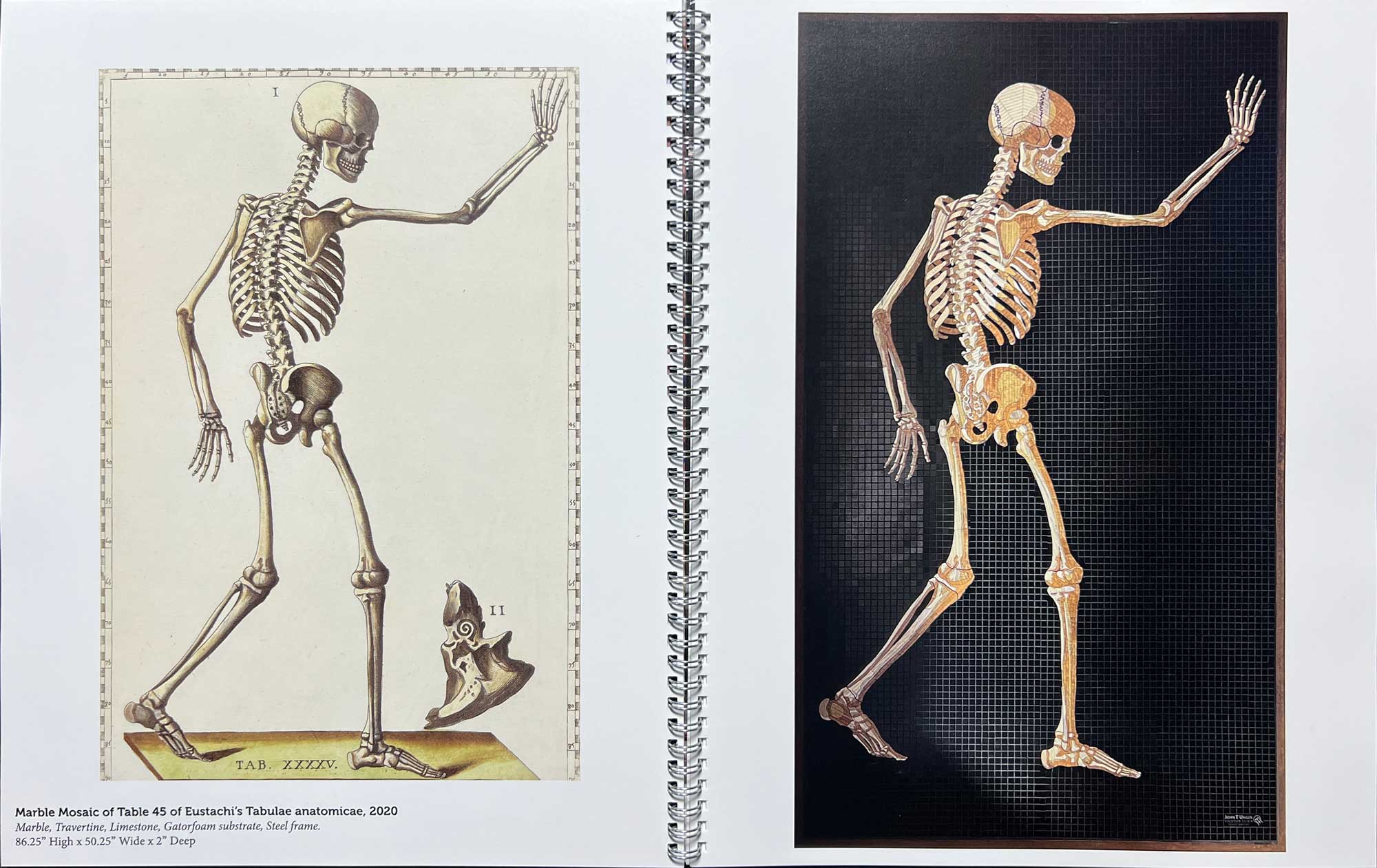
Etching and marble mosaic of Table 45 of Eustachi’s Tabulae anatomicae as seen in catalog spread.
| Anatomy Set in Stone | 60 Pages, 28 × 36 cm (11 × 14 in.), wire bound, full color |
|---|